


Combining Delphi and Meteora from Athens packs Greece’s most famous mainland sights into one compact trip: the oracle of Apollo high above the Gulf of Corinth and the gravity‑defying monasteries perched on sandstone pinnacles near Kalambaka. With smart routing, you can fit both into anything from a long day and a night to a more relaxed three‑night road trip, choosing between independent driving and guided tours depending on your comfort level and budget.
Understanding the Route: Athens, Delphi and Meteora
The classic loop from Athens runs northwest to Delphi, then north across central Greece to Meteora, and finally back south to Athens. By road, Athens to Delphi is roughly 180 kilometers, usually 2.5 to 3 hours of driving depending on traffic leaving the capital. From Delphi to the town of Kalambaka, the base for Meteora, you cover around 220 to 230 kilometers in about 3 hours on a mix of mountain and highway driving. The return from Kalambaka to Athens is the longest stretch at around 350 kilometers and 4 to 5 hours on the main highway through Thessaly and central Greece.
On a map it can look intimidating, but the roads are mostly good quality, especially the main highway between Athens and Lamia and onward to Trikala. The twistier sections are between Livadeia and Delphi and then again as you leave Delphi to drop into the Thessalian plain. This is why many travelers either spread the drive over two or three days or opt for a structured 2‑day tour that includes overnight accommodation and transport so they do not have to white‑knuckle the roads while also trying to sightsee.
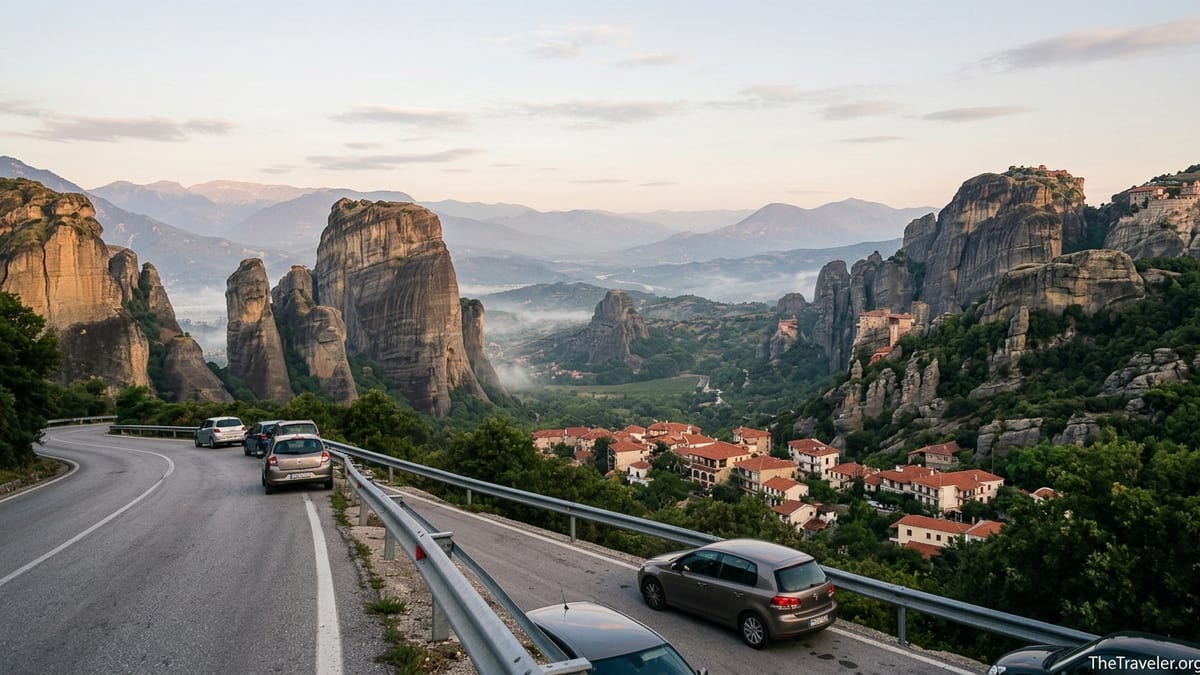
The other reason to think in terms of a loop is that both Delphi and Meteora reward an overnight stay. Delphi is quiet and atmospheric in the evening once day‑trippers leave, and Meteora is at its most magical around sunrise and sunset when tour buses thin out and the rock pillars catch low, golden light. Planning your route with at least one night at either or both stops dramatically changes the quality of the experience compared with trying to rush everything as day trips from Athens.
If you prefer not to drive, you can still follow essentially the same geographic route by combining intercity KTEL buses and regional trains, but connections between Delphi and Meteora are awkward and time‑consuming. That is why most non‑drivers either book an organized Delphi and Meteora package from Athens or treat the two destinations as separate overnight trips rather than a single continuous loop.
Driving vs Tours: What Suits You Best
For confident drivers, renting a car in Athens and doing the loop independently offers maximum flexibility. A typical compact rental car in high season might cost around 40 to 60 euros per day from a well‑known company if booked in advance, with extra for full insurance and tolls on the main highways between Athens and Lamia. That is often cost‑effective for two or more people compared with guided tours, particularly if you plan to add side trips such as the mountain village of Arachova, the seaside town of Galaxidi, or the battlefield of Thermopylae on your way back from Meteora.
The trade‑off is the stress of driving out of Athens and navigating mountain roads. Exiting the city can involve busy multilane avenues and aggressive lane changes, especially around peak commuter hours. Once you are on the national road the drive becomes easier, but there are still stretches with narrow shoulders and trucks. In Delphi and Meteora themselves, the challenge is less about traffic and more about tight parking near the archaeological site and monasteries, especially in July and August. Travelers who are used to North American highways often report that they underestimated how tiring Greek driving days can feel.
Organized tours solve those issues at a premium. A typical 2‑day Delphi and Meteora group tour from Athens, booked through a major platform or Athens travel agency, often starts around 230 to 300 euros per person in a shared coach, including transport, a licensed guide at Delphi, an overnight in a 3‑star or 4‑star hotel in Kalambaka or nearby Kastraki, and breakfast. Some include dinner and entrance fees; others keep those separate, so it is important to check what “includes” actually cover. Private 2‑day tours with a dedicated driver can easily run 600 to 900 euros total or more, but make sense for small groups who value door‑to‑door convenience and the ability to customize stops.
The key factor is how much independence you want once you reach Delphi and Meteora. Tours are ideal if you prefer not to think about logistics and do not mind a set pace, with structured visits to a couple of Meteora monasteries and a fixed overnight in Kalambaka. Self‑drivers can arrive earlier or later, choose which monasteries to visit, linger for sunset at lesser‑visited viewpoints, or deviate via places like the historic mountain village of Metsovo for lunch. For many travelers, a hybrid approach works well: for example, drive yourself but book a small‑group sunset tour in Meteora so a local guide handles the viewpoints and monastery timing while you park the car at your hotel.
One‑Night Option: The Fast‑Track Loop
With only one night to spare, the most time‑efficient way to see both Delphi and Meteora is to overnight in Kalambaka or Kastraki after visiting Delphi on the way north. You would leave Athens early in the morning, ideally by 7 or 8 a.m., to reach Delphi late morning. This gives you around three hours to visit the archaeological site and museum. For instance, many travelers report arriving at Delphi around 11 a.m., spending two hours on the Sacred Way, Temple of Apollo and theater, then another hour in the air‑conditioned museum before a late lunch in Delphi town overlooking the olive groves.
From Delphi, you would then drive to Kalambaka in the mid‑afternoon, arriving early evening. In summer, this might mean leaving Delphi between 3 and 4 p.m. and reaching Kalambaka around 7 p.m., just in time to check into a hotel and enjoy dinner with the rock formations silhouetted against the sky. In Kalambaka, mid‑range hotels like those clustered along Trikalon Street often offer simple rooms with balconies facing Meteora and easy parking, while in Kastraki you find family‑run guesthouses with more village atmosphere and direct views of the rocks rising behind the houses.
The following morning becomes your Meteora window. If you want to visit inside at least a couple of monasteries, plan to start around 9 a.m., when most open. A realistic one‑night itinerary might allow visits to two monasteries, a few scenic viewpoints and a short walk along one of the old footpaths linking monastery complexes, before you begin the long drive back to Athens around 2 or 3 p.m. This usually gets you into Athens early evening, even with rest stops at highway service stations or a short detour to see the Thermopylae monument, which lies just off the main road and can be visited in under half an hour.
This compressed loop works best outside the hottest months and for travelers comfortable with back‑to‑back driving days. It is not ideal for families with small children or anyone wanting leisurely lunches and long photography stops. However, for visitors who have limited time on the mainland before heading to islands like Santorini or Naxos, it offers a practical way to see both UNESCO‑listed sites in about 36 hours door to door from Athens.
Two‑Night Option: The Classic Delphi & Meteora Itinerary
Spending two nights transforms the experience and is arguably the sweet spot for most travelers. One popular pattern is Athens to Delphi for the first night, Delphi to Meteora for the second night, then Meteora back to Athens. On day one you leave Athens mid‑morning, reach Delphi by early afternoon, check into your hotel and visit the museum first to escape the heat, then walk the archaeological site in the later afternoon when light softens and crowds thin. You can then enjoy dinner on Delphi’s main street with views down to the Gulf of Corinth, perhaps at a taverna serving grilled lamb chops and local feta baked with tomatoes.
On day two you drive from Delphi to Meteora. If you leave around 10 a.m., you can stop for coffee in one of the small towns on the Thessalian plain and still make it to Kalambaka around early afternoon. That gives you time either for an initial driving loop around the Meteora road, stopping at viewpoints, or for a guided sunset tour that visits a monastery and several panoramic spots. Many small local agencies in Kalambaka and Kastraki advertise these sunset tours in hotel lobbies, often costing somewhere in the range of 30 to 40 euros per person in a small bus.
Day three is your main Meteora visiting day. Starting early allows you to beat the bulk of the coach groups that tend to arrive mid‑morning. You might visit three monasteries, for example the Great Meteoron, Varlaam and either Rousanou or Agios Stefanos, each involving a short climb up stone staircases from the road. Modest dress codes are enforced, with long skirts or wraps for women and covered shoulders for everyone; some monasteries lend or rent wraps at the entrance. After lunch in Kastraki or Kalambaka, you can either drive straight back to Athens or, if you are continuing north for a wider mainland loop, carry on towards Thessaloniki or the Zagori villages instead.
This two‑night pattern works equally well in reverse, with the first night in Meteora and the second in Delphi. That version suits people arriving overland from northern Greece or flying into Thessaloniki and then looping down to Athens. Whichever order you choose, two nights give you evenings in each place, which is when both sites feel most atmospheric and the tour buses have gone. You also gain breathing space for weather surprises, such as low clouds around the Meteora cliffs or rain showers that might otherwise compress everything into one rushed window.
Three‑Night Option: A Deeper Mainland Road Trip
If you can spare three nights, you can turn Delphi and Meteora into the backbone of a broader central Greece trip with time for detours and slower mornings. One appealing pattern is: Athens to Delphi (night one), Delphi to Meteora (nights two and three), then Meteora back to Athens or onward to another region. This gives you two full days around Meteora, which many travelers find ideal if they want to mix monastery visits with hiking or photography.
For example, on your first full day in Meteora you might book a morning hiking tour that follows old forest paths and rock steps up to hidden hermitages, seeing the monasteries from below and away from the main road. In the afternoon, you could visit two monasteries at a relaxed pace. The next day you might rent bikes in Kalambaka, visit a couple more monasteries, and save sunset for a specific viewpoint you have scouted, such as the lay‑by between Varlaam and Rousanou where many photographers set up tripods. With two nights, you are not forced to cram all of this into a single whirlwind day.
Three nights also allow more variety between Athens and Delphi. On the way from Athens you might schedule a lunch stop in the mountain town of Arachova, known for its stone houses, narrow streets and winter ski culture, then arrive in Delphi later in the afternoon once many buses have left. Alternatively, you might drive the coastal road via the town of Galaxidi and then climb up to Delphi from the sea, enjoying a coffee by the harbor before heading into the mountains. On your way back from Meteora, you could pause at Thermopylae to see the Leonidas monument and steaming hot springs, or detour into the town of Trikala for a riverside lunch.
Another way to use a third night is to split your time between Delphi and the Peloponnese, visiting Delphi first then crossing back towards Athens and continuing to Nafplio or Epidaurus instead of Meteora. Some travelers even link all three regions in a longer triangle, but if your focus is Delphi and Meteora specifically, dedicating the extra nights to slower exploration around those sites and neighboring villages usually feels more rewarding than racing between too many famous names.
Where to Stay: Athens, Delphi and Meteora Bases
In Athens, most visitors base themselves around areas like Syntagma, Plaka or Monastiraki before and after the Delphi and Meteora loop. These neighborhoods offer easy access to pick‑up points for early‑morning tours and straightforward routes out of the city for drivers. If you are collecting a rental car, it is often easier to pick it up from a downtown office on the edge of the center or from the airport and drive directly towards Delphi, rather than trying to navigate very narrow streets in the older quarters.
In Delphi, you will be choosing between the modern hillside town and the nearby mountain village of Arachova. Delphi town sits a short walk or quick drive from the archaeological site and museum, with simple hotels and guesthouses lining the main road. Many rooms have balconies that look south over a sea of olive trees towards the Gulf of Corinth, and prices for mid‑range doubles commonly fall in a moderate bracket outside peak August, especially if you book shoulder seasons like May, June or late September. Staying in Delphi allows you to walk to dinner and to reach the site when it opens in the morning without a long drive.
Arachova, about a 15 to 20 minute drive from the site, offers a slightly more upscale atmosphere, with boutique hotels, ski‑chalet‑style lodgings and chic bars. Many Athenians come here for winter weekends at the nearby Parnassos ski area, so you will see stylish cafes next to old stone houses. It makes sense as a base if you have your own car and prefer a village feel with more evening life, accepting that you will need to drive to and from the archaeological zone. Some travelers split the difference by staying one night in Delphi town then another in Arachova on a slower itinerary.
Around Meteora you choose between Kalambaka and Kastraki. Kalambaka is the larger town at the foot of the cliffs, with a full range of accommodation from budget guesthouses to modern hotels with pools, plus more restaurants, supermarkets and tour offices. It is convenient if you are arriving by train or bus, as most services terminate in Kalambaka. Kastraki is a smaller village tucked closer to the rocks, with narrower streets and a quieter feel. Many visitors prefer Kastraki for its direct views up to the monasteries and easier access to some of the hiking paths, while still being only a few minutes by car or taxi from Kalambaka’s amenities.
Public Transport and Tour Alternatives
Travelers who do not want to drive have several alternatives, but they typically involve trade‑offs in time and flexibility. Athens to Delphi is served by KTEL intercity buses departing from the main bus station in the city, often taking around 3 hours with a brief stop. This works well for an overnight Delphi trip, allowing you to arrive by midday, visit the site, spend the night and return to Athens the next day. It is less convenient if you hope to continue directly from Delphi to Meteora because there is no direct rail link and bus connections require changes via regional towns like Lamia or Trikala.
Between Athens and Meteora, many travelers use the train to Kalambaka from Athens’ main railway station. Journey times are often in the range of 3.5 to 4.5 hours depending on whether you have a direct service or a change at Paleofarsalos. Once in Kalambaka, local tour companies and hotels can arrange minibus excursions up to the monasteries and viewpoints, making it possible to explore Meteora without a car. You can then return to Athens by train the next day, effectively treating Meteora as a separate 1‑ or 2‑night break from the capital.
For combining both Delphi and Meteora without driving, a packaged tour from Athens is usually the most straightforward option. These itineraries typically leave Athens early on day one, visit Delphi with a licensed guide, continue by coach to Kalambaka for the night, and then spend day two visiting two or three monasteries before returning to Athens via Thermopylae. They often include one breakfast and may offer a choice between “tourist class” and “first class” hotels for the overnight. Travelers who have taken these tours often note that they provide good value for money when you factor in fuel, tolls and hotel cost, but feel busy, with limited time for independent wandering.
A hybrid approach is to travel independently to either Delphi or Meteora, then join local tours on arrival. For example, you might take the bus to Delphi, stay overnight and explore at your own pace, then return to Athens and later take the train to Kalambaka, where you book a small‑group sunset tour and a separate morning hiking tour. This splits the trip into two segments but still allows you to see both sites with guides when you want them, without committing to a single long coach tour.
What Else to See Along the Way
One of the advantages of traveling independently between Athens, Delphi and Meteora is the chance to explore lesser‑known places along the route. Arachova is the obvious extra stop near Delphi, with its stone alleys, local cheese and hand‑woven textiles. Just beyond Delphi, the road drops towards the coast and the small town of Itea, where you can detour to the harbor village of Galaxidi for a seafood lunch on the waterfront and a stroll among neoclassical houses before heading inland again. This coastal detour adds time but gives a sense of how the ancient sanctuary connected to the sea routes of the Gulf of Corinth.
Between Delphi and Meteora, the drive takes you through the agricultural heartland of central Greece. Small towns on the Thessalian plain offer opportunities to stop at local bakeries for spanakopita or bougatsa, or to sample grilled meats at roadside tavernas catering to truck drivers. If you feel like a longer break, the town of Trikala has a walkable center with a riverside promenade and cafes shaded by plane trees, making it a pleasant place to stretch your legs before continuing to Kalambaka.
On the way back from Meteora to Athens, the Thermopylae pass makes an evocative short stop. Today it is a rather ordinary stretch of highway and hot springs, but a monument to King Leonidas and interpretive signs recall the famous battle between the Spartans and Persians. Another possible add‑on for those extending their trip is the mountain village of Metsovo, east of Ioannina, known for its stone architecture and cheeses. Although it lies a bit off the most direct route between Meteora and Athens, some travelers fold it into a wider mainland loop that also includes the Vikos Gorge and Zagori villages before eventually reaching Meteora from the northwest.
Not everyone will have time for these extras, especially on tight one‑night itineraries, but even short stops can break up the long driving days and give a broader sense of Greek landscapes beyond the famous ruins and monasteries. Building in such pauses also helps with driver fatigue, which is an important consideration on a trip where daily legs of 3 to 5 hours behind the wheel are common.
The Takeaway
Delphi and Meteora pair naturally from Athens, offering a condensed journey from the mythic heart of ancient Greece to one of its most extraordinary monastic landscapes. The loop looks long on the map, but with realistic planning it works across a range of timeframes, from a single overnight dash to a three‑night road trip with room for detours. Your key decisions revolve around whether to drive or join a tour, how many nights to allocate, and whether you prefer the convenience of towns like Kalambaka and Delphi or the quieter ambiance of villages like Kastraki and Arachova.
For many visitors, two nights split between Delphi and Meteora provide the best balance, allowing for sunset light on the ruins, dawn mist around the rock pillars and enough flexibility to handle crowds or weather variations. One night is feasible if you treat the journey itself as part of the adventure and accept long days, while three nights unlock slower hikes, extra monasteries and unhurried coffees in mountain squares. Whether you travel by rental car, bus and train or a guided coach, the combination delivers a powerful contrast to Athens and the islands and leaves most travelers feeling that they have glimpsed a deeper layer of mainland Greece.
FAQ
Q1. Is it realistic to visit both Delphi and Meteora in one day from Athens?
It is technically possible on a very long private tour, but not recommended. Travel times alone make it exhausting: you would spend 8 to 9 hours in the vehicle and only a few hours at the sites. Staying at least one night, usually in Kalambaka or Delphi, leads to a far better experience.
Q2. Should I stay in Kalambaka or Kastraki for Meteora?
Kalambaka offers more hotels, restaurants and easy access from the train or bus, so it suits travelers who want convenience and services. Kastraki is quieter and closer to some hiking paths and viewpoints, with many small guesthouses that look straight up at the rock pillars. Both work well; your choice depends on whether you prioritize amenities or atmosphere.
Q3. Do I need to rent a car to see Delphi and Meteora?
No, but having a car gives you maximum flexibility. Without driving, you can reach Delphi by bus and Meteora by train plus local tours. To combine them in a single continuous trip without returning to Athens, most non‑drivers find that an organized 2‑day or 3‑day tour is the simplest option.
Q4. How many monasteries can I realistically visit in one day at Meteora?
Most travelers comfortably visit two or three monasteries in a day, allowing time for the stair climbs, interior visits and viewpoints in between. Trying to rush through more often becomes repetitive and tiring, especially in hot weather, and leaves little time for enjoying the landscape itself.
Q5. When is the best time of year to combine Delphi and Meteora?
Late spring and early autumn, roughly May to June and September to early October, are ideal. Days are long enough for driving, temperatures are milder than peak summer, and crowds are more manageable. Winter can be atmospheric but brings shorter days and possible snow around Meteora and Mount Parnassos.
Q6. Are guided tours at the sites worth it if I am driving myself?
Many visitors find a licensed guide particularly valuable at Delphi, where much of the story lies in what is no longer visible. In Meteora, local guides help you choose which monasteries and viewpoints to prioritize and explain monastic life and rock formations. Booking a half‑day guided tour in each place, even if you otherwise travel independently, can deepen the experience.
Q7. What should I wear to visit the Meteora monasteries?
Modest dress is expected. Shoulders should be covered, shorts should be at least knee‑length, and women are usually asked to wear skirts rather than trousers, although some monasteries provide wraparound skirts at the entrance. Comfortable walking shoes with good grip are essential because paths and steps can be uneven and slippery.
Q8. How early should I start from Athens if I want to see Delphi on the way to Meteora?
Leaving Athens between 7 and 8 a.m. works well for most people. That timing typically gets you to Delphi late morning, allows a few hours at the site and museum plus lunch, and still gives enough daylight to reach Kalambaka or Kastraki by early evening, even with short rest stops en route.
Q9. Can I use public transport between Delphi and Meteora without going back to Athens?
It is possible but involves multiple changes and long travel days, usually with buses through regional hubs such as Lamia or Trikala. Schedules may not align conveniently, and services can be less frequent outside peak seasons. For most travelers, this route is only worth attempting if you are very flexible with time and comfortable with changing plans.
Q10. Is a 2‑day group tour from Athens enough to see both sites properly?
A well‑run 2‑day Delphi and Meteora tour from Athens gives a solid overview: you typically get a guided visit and free time at Delphi, an overnight in Kalambaka, and a visit to two or three monasteries plus viewpoints at Meteora. It feels busy but efficient and is usually the best compromise for travelers who want both sites and have only two days to spare.