


The Dodecanese might look close together on a map, but traveling between Rhodes, Kos and the smaller islands still requires careful ferry planning. Schedules change by season, fast boats and conventional ferries operate on different days, and some routes only run a few times a week. This guide walks you through how the network really works in 2026, how to book, and how to connect the dots between big hubs like Rhodes and Kos and smaller islands such as Symi, Kalymnos, Nisyros, Patmos and Kastellorizo.
Understanding the Dodecanese ferry network
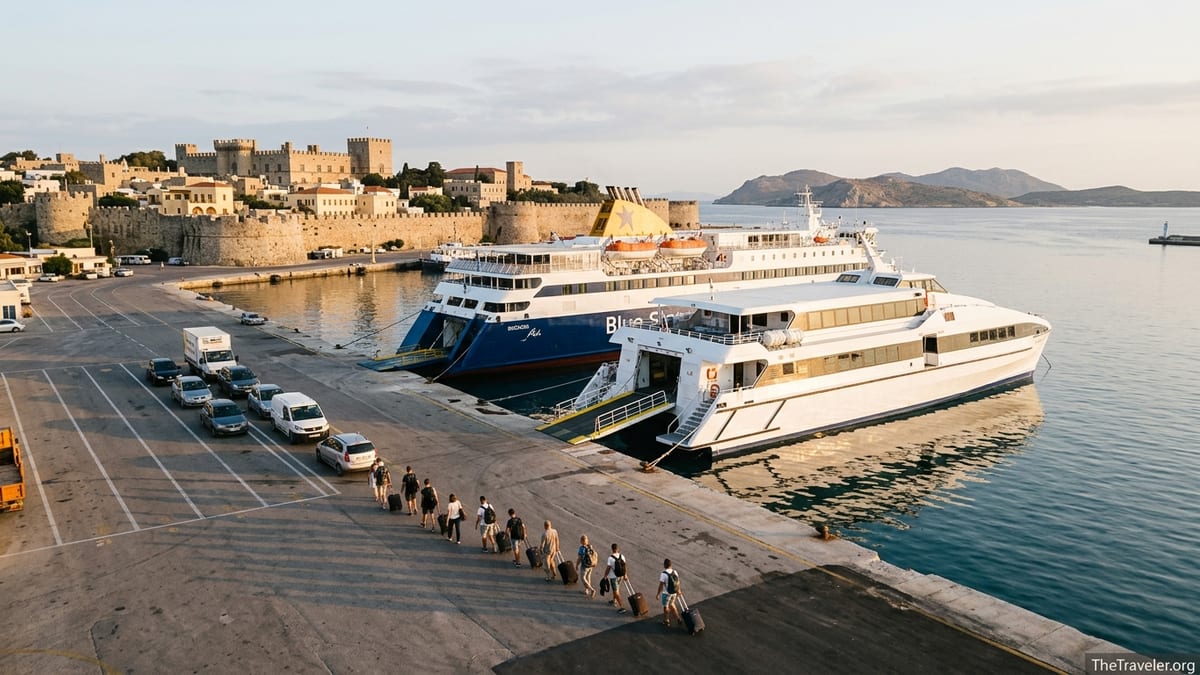
The Dodecanese is a chain of islands in the southeastern Aegean, including Rhodes, Kos, Symi, Kalymnos, Leros, Patmos, Nisyros, Tilos, Kastellorizo and others. In practice, ferries operate on a hub-and-spoke system. Rhodes and Kos are the main hubs, with most routes either starting or passing through one of these two islands before continuing to smaller destinations. For example, Dodekanisos Seaways runs high-speed catamarans linking Rhodes with Symi, Kos, Kalymnos, Leros, Lipsi and Patmos on multi-stop runs, while Blue Star Ferries operates larger conventional ships that connect Piraeus to Rhodes and Kos with stops at several intermediate islands.
For many travelers, the key is to accept that you will route through Rhodes or Kos even when two smaller islands look close together. A common pattern is to fly into Rhodes, spend a night in the city, then take a morning catamaran to Symi, Tilos or Nisyros. Alternatively, travelers who land at Kos often use it as a springboard for Kalymnos, Nisyros or Patmos. Links between small islands without going via a major hub do exist, but they may only run once or twice a week. For instance, summer timetables have shown just a couple of weekly sailings between islands like Chalki and Symi, which makes direct hops harder to rely on if you have fixed dates.
Another important feature of the network is that most long-distance ferries between Piraeus and the Dodecanese run overnight and call at several islands on the way. A typical Blue Star route might leave Piraeus in the late afternoon, pass through islands such as Patmos, Leros, Kalymnos and Kos during the night and early morning, and reach Rhodes around midday. This multi-stop structure can be useful if you want to reach smaller islands without backtracking, but it also means that arrival and departure times may be at awkward hours like 02:30 or 05:00.
The network is highly seasonal. From roughly late June through early September, there are generally more sailings per week, especially on high-speed services like Dodekanisos Seaways’ Dodekanisos Express and Dodekanisos Pride, and on local boats like Panagia Skiadeni that run busy Rhodes to Symi and Tilos routes. In April, May and October, most ferries still run but with reduced frequency, while in winter some connections drop to one or two sailings per week or pause altogether. Always check the exact dates you are traveling, rather than assuming a July schedule applies in October.
Key routes between Rhodes, Kos and nearby islands
For many visitors, the most important link in the southern Dodecanese is Rhodes to Kos. In summer 2026, fast catamarans such as Dodekanisos Express are scheduled to make the Rhodes to Kos run in about 2 hours 20 minutes, usually with a few intermediate stops, while conventional ferries like Blue Star vessels take closer to 3 hours 15 minutes on direct or near-direct sailings. On a typical late-July week you might see a morning high-speed departure from Rhodes around 08:00, arriving in Kos shortly after 10:00, and an afternoon or evening conventional ferry that leaves mid to late afternoon and arrives early evening. This pairing allows you to pick either speed or a more leisurely, often cheaper crossing.
Shorter hops from Rhodes are popular day-trip or short-stay options. The Rhodes to Symi route is especially busy in high season. High-speed boats can cover this in under an hour, with some Dodekanisos Seaways sailings listed around 50 minutes, while larger conventional ferries like those operated by Blue Star tend to take roughly an hour to 90 minutes depending on stops. Many visitors use the early-morning sailing from Rhodes to Symi, spend the day in Symi’s harbor and then return on a late-afternoon boat. Others travel with luggage and stay several nights on Symi, taking advantage of the fact that both fast and conventional ferries accept checked bags.
Rhodes also connects to smaller islands such as Chalki, Tilos and Nisyros. For example, some Dodekanisos Seaways itineraries link Rhodes to Chalki, Tilos, Nisyros, Kos and beyond in a single multi-stop run. On a summer Monday, you might see a high-speed catamaran leave Rhodes in the morning, stop at Chalki mid-morning, reach Tilos around midday and continue towards Nisyros and Kos in the afternoon. Local car ferries like Panagia Skiadeni may also operate Rhodes to Symi or Tilos routes, offering a slower but more stable ride that some travelers prefer if they are prone to seasickness.
From Kos, there is a cluster of relatively short crossings that open up the central Dodecanese. Common trips include Kos to Kalymnos in around 45 minutes to an hour on local ferries, and Kos to Nisyros in roughly 1 hour 30 minutes. These services tend to be a mix of small local boats and larger conventional ferries. During high season, Kos also features in long multi-island routes from Piraeus or Samos that call at Patmos, Leros, Lipsi and other islands, making it a useful pivot if you are trying to connect the Dodecanese with the North Aegean or Cycladic islands.
Mainland Greece to Rhodes, Kos and beyond
Most international travelers start or end their Dodecanese trip in Athens. The main ferry port for Dodecanese services is Piraeus, on the outskirts of Athens. From Piraeus, conventional ferries run all year to Rhodes, usually with several departures per week and up to two per day in peak summer. These are typically operated by Blue Star Ferries on large overnight ships such as Blue Star Patmos or similar vessels. Crossing times average 15 to 18 hours depending on the number of intermediate stops and sea conditions, so many travelers book a cabin rather than trying to sleep in airline-style seats.
Prices on the Athens to Rhodes route vary by season and accommodation class but expect a rough range of around 60 to 90 euros per person for a standard deck or economy seat in high season, while inside cabins can easily climb above 150 euros for two people. Vehicle fares are additional and can be significant: taking a standard car from Piraeus to Rhodes can easily add a few hundred euros in peak season. These figures change every year, but they give a realistic sense that long-haul Dodecanese routes are a major transport expense, comparable in cost to a budget flight, though ferries allow vehicles and more luggage.
On the way between Piraeus and Rhodes, the same ship may call at several Dodecanese ports such as Patmos, Leros, Kalymnos, Kos, Nisyros and Symi, depending on the exact itinerary. Travelers use these intermediate calls to reach smaller islands without flying. For example, you might leave Piraeus at 18:00, arrive in Patmos around 03:00, Leros around 04:00, Kos just after dawn and Rhodes around lunchtime. These unsociable hours can actually be useful: if you are comfortable boarding or disembarking at night, you can wake up already on a smaller island and avoid a day lost in transit.
There are also seasonal and occasional routes involving other mainland ports. In some recent seasons, ferries have linked Dodecanese islands with northern ports such as Thessaloniki or with islands in the North Aegean, though these are less predictable and often change from year to year. Because of this volatility, travelers with tight schedules usually stick to the more reliable Piraeus link, then rely on local networks like Dodekanisos Seaways or Leros Seaways to fan out through the archipelago. Checking current timetables on Greek language resources, or via multi-operator platforms, is essential, particularly outside July and August.
Fast ferries vs conventional ships in the Dodecanese
When planning connections between Rhodes, Kos and the smaller islands, you will usually be choosing between fast ferries and conventional ships. Fast ferries in the Dodecanese are typically high-speed catamarans operated by companies such as Dodekanisos Seaways. Their vessels, including Dodekanisos Express and Dodekanisos Pride, connect many islands on long, multi-stop runs. On routes like Rhodes to Kos or Rhodes to Symi they can be substantially quicker than conventional ferries, shaving an hour or more off the crossing compared with larger boats. Fast ferries generally have indoor airline-style seating with numbered seats, café service and limited outdoor deck space.
Conventional ships are larger monohull ferries, usually operated by companies like Blue Star Ferries and occasionally smaller local firms. They are slower, but they have more open decks, larger lounges and a calmer ride in rough seas. For example, if you are prone to seasickness and traveling the Rhodes to Symi route on a windy day, many travelers prefer a larger conventional ferry such as Panagia Skiadeni or a Blue Star vessel because it is more stable and spacious. These ships also carry more vehicles and offer cabins on longer routes, something fast catamarans rarely do.
In terms of pricing, fast ferries are usually more expensive for the same route. A Rhodes to Kos ticket on a summer high-speed catamaran might cost a noticeable premium over a slower conventional ferry, even on the same day. The trade-off is time and convenience. If you are on a tightly timed itinerary, catching an 08:00 high-speed from Rhodes to Kos that arrives around 10:20 can make same-day onward travel much easier than a mid-afternoon conventional boat. On the other hand, budget-conscious travelers or those who enjoy being on deck often choose the slower ship, especially when seas are calm.
Another important difference is sensitivity to weather. High-speed catamarans are more likely to be canceled or modified during strong winds compared with big conventional vessels. In early May 2026, for instance, Blue Star Ferries issued notices about itinerary changes and delays due to bad weather, highlighting how quickly schedules can shift when the Meltemi wind picks up. This does not mean conventional ships never cancel, but they are generally more resilient, while fast ferries can have last-minute day-of-travel changes. Whenever you are relying on a fast ferry for a flight connection or to link two non-daily routes, it is safer to build in a buffer of at least half a day at your connecting island.
Booking ferry tickets and choosing platforms
Booking Dodecanese ferries has become much easier in recent years, but there are still a few tricks to avoid stress. Most major operators, such as Blue Star Ferries and Dodekanisos Seaways, sell tickets directly through their own websites and at their physical ticket offices in ports like Rhodes and Kos. In addition, multi-operator booking platforms aggregate schedules and sell e-tickets for many lines, allowing you to see a week of options at once and compare times and prices. These platforms often show exact departure and arrival times, vessel names, and cabin or seat options.
For peak months such as late July and August, it is wise to pre-book key legs like Piraeus to Rhodes or Rhodes to Symi several weeks in advance, especially if you need a cabin, are taking a vehicle, or are traveling on a weekend. For shorter inter-island hops such as Kos to Kalymnos or Leros to Patmos, you can often buy tickets a few days before travel, or even on the day, depending on your flexibility. However, travelers in 2026 have reported that some popular short routes can sell out on peak days, especially fast ferries timed for same-day flight connections, so leaving it to the last minute during a busy week in August is risky.
When comparing platforms, pay attention to extra booking fees and ticket change policies. Some third-party sites add several euros per ticket in service charges, which quickly adds up for a family or multi-leg itinerary. Others offer slightly better flexibility to change dates for a fee. If you are comfortable navigating Greek websites, booking directly with the operator can sometimes be cheaper and give you more direct control in case of schedule changes or cancellations. For example, if a Dodekanisos Seaways sailing is adjusted due to weather, being able to manage your booking directly with the company can speed up rebooking.
Many tickets in 2026 are issued as e-tickets or mobile boarding passes, especially on major lines. However, some smaller local ferries and older systems still require a printed ticket that you pick up at a port kiosk or travel agency before boarding. If your confirmation email mentions a “ticket collection” step, allow at least 30 minutes in port before departure to queue and collect paper tickets. On islands with small ports like Symi or Nisyros, there may be only one or two agencies handling multiple departures, so lines can form just before a departure, particularly when a large Blue Star ferry is in port.
Luggage, vehicles and boarding on Dodecanese ferries
Luggage policies in the Dodecanese are generally generous, especially compared with airlines. On most ferries you can bring standard suitcases, backpacks and smaller bags without additional fees, as long as you can handle them yourself. Travelers routinely board with 20 kilogram suitcases on routes like Rhodes to Symi or Rhodes to Kos. On larger ships, there are designated luggage storage racks near the vehicle deck entrance or stairways, where you leave bigger bags during the crossing, and take only a small daypack with valuables upstairs to your seat. On fast catamarans, crew may direct you to specific luggage areas at the bow or stern.
There is usually no formal luggage weight check, but practically you need to be able to carry your bags up and down ramps and gangways. Ports like Rhodes and Kos have wide, gently sloping ramps, while smaller islands like Symi or Kalymnos can involve steeper ramps or steps and uneven quays. If you are traveling with multiple large suitcases, it is worth arriving early so you can board at a relaxed pace and get help from crew if needed. Keep passports, tickets, money and electronics in a small bag that stays with you, since luggage racks are communal and not locked.
Taking a car on Dodecanese ferries is straightforward on conventional ships but not usually possible on fast catamarans, which are often for passengers only. When booking, you will enter the vehicle length and type, then receive a boarding card with a lane number. At ports like Piraeus, Rhodes and Kos, you line up your car in the marked lanes well before departure, typically at least 60 to 90 minutes before sailing on busy overnight routes. Crew direct vehicles on board, and loading can be a tight fit with cars, vans and motorcycles parked bumper to bumper. It is important to take photos of where you parked inside the ship to avoid confusion when disembarking in the early morning at an intermediate island.
Boarding as a foot passenger is usually a matter of queuing at the port gate 20 to 45 minutes before departure. On larger ships, boarding and disembarkation can feel chaotic, with streams of passengers, cars and trucks moving at once. Keep to the side, follow crew instructions and avoid stopping in vehicle lanes to take photos. On small islands, embarkation is much calmer, sometimes with the entire crowd of 50 or 60 passengers walking on and off the rear ramp in a few minutes. Always have your ticket or mobile boarding pass ready, along with an ID, since crew may request to see the name on the ticket, especially on overnight routes.
Planning connections and multi-island itineraries
The most common planning mistake in the Dodecanese is trying to combine too many islands in too few days. Because some routes run only a few times a week and are vulnerable to weather, it is wise to build an itinerary around a few key hubs and then add smaller hops. A classic two-week plan might look like this: fly to Rhodes, spend three nights there, take a morning ferry to Symi for three nights, return to Rhodes, then use a high-speed ferry to reach Kos for four nights, with side trips to Kalymnos or Nisyros. This pattern uses Rhodes and Kos as anchor points with multiple daily departures, reducing the risk that a cancellation will strand you.
For more adventurous travelers, the multi-stop catamaran routes can turn the ferry itself into a scenic island-hopping tour. For example, a Dodekanisos Express sailing might depart Rhodes, stop at Symi, then Tilos, Nisyros, Kos, Kalymnos, Leros, Lipsi and Patmos all in a single long day. You could ride the same vessel only as far as Nisyros for a short stay, then catch it or another ferry onward a few days later to Kos or Leros. Multi-leg tickets are sometimes available, but it can be simpler to book each leg separately to preserve flexibility. Just be sure to check that onward sailings operate on the days you plan to move, especially between smaller islands like Chalki and Symi, where schedules can drop to twice weekly.
Connection planning is particularly important when linking ferries with flights. If you are flying home from Rhodes or Kos, aim to arrive at your departure island at least one day before your flight, rather than assuming a same-day ferry will be reliable. In recent seasons, travelers in Greece have reported last-minute cancellations of high-speed ferries on other routes due to operational changes and weather, highlighting how fragile tight connections can be. A safe pattern is to plan your last inter-island ferry two days before your international flight, then use the intervening time as a buffer to explore the main port town, such as Rhodes Old Town or Kos Town.
Finally, remember that not all islands link easily with each other, even if they are close on the map. Kastellorizo, perched far to the east near the Turkish coast, is typically reached via longer routes that start in Piraeus or Rhodes and call at several islands along the way. Likewise, Astypalaia, at the northwest edge of the Dodecanese, is more easily combined with Cycladic or North Aegean itineraries rather than slotted casually into a Rhodes and Kos program. Checking a recent ferry map or timetable that shows entire routes, not just point-to-point searches, can reveal these patterns and help you build a realistic loop instead of relying on assumed direct links.
The Takeaway
Navigating ferries between Rhodes, Kos and the smaller Dodecanese islands is less about memorizing every route and more about understanding how the network behaves. Rhodes and Kos act as hubs, fast ferries bring speed but more weather sensitivity and higher prices, and conventional ships offer stability, open decks and vehicle capacity. Schedules are fuller and more frequent in July and August, thinner in spring and autumn, and sparse in winter.
If you prioritize reliability, anchor your itinerary around Rhodes and Kos, build in at least a one-day buffer before flights, and favor conventional ships for crucial connections. If you prioritize exploration, use multi-stop catamarans to string together islands like Symi, Nisyros, Kalymnos, Leros and Patmos, but keep your schedule flexible enough to absorb a canceled or retimed sailing. In both cases, book key routes in advance, watch for schedule changes in the week before you travel and allow generous time for boarding and collecting tickets in port.
With realistic expectations and a bit of strategic planning, the Dodecanese ferry network becomes less of a puzzle and more of an invitation. It allows you to drift between medieval Rhodes, low-key Kos, pastel-hued Symi, volcanic Nisyros and remote corners like Patmos and Kastellorizo at a human pace. The reward for doing the homework is a trip where the journeys between islands are as memorable as the islands themselves.
FAQ
Q1. Do I need to book Dodecanese ferry tickets in advance or can I buy them on the day?
In July and August, it is sensible to book major legs like Piraeus to Rhodes or Rhodes to Symi at least a few weeks ahead, especially if you need a cabin or are traveling with a car. For shorter inter-island hops such as Kos to Kalymnos or Leros to Patmos, you can often buy tickets a few days in advance or even on the day outside peak weekends, but popular fast ferries can still sell out, so last-minute purchases in high season always carry some risk.
Q2. How early should I arrive at the port before my ferry departs?
For large overnight ferries from Piraeus or major routes from Rhodes and Kos, aim to be at the port 60 to 90 minutes before departure, especially if you have a vehicle or need to collect paper tickets. For shorter inter-island passenger ferries where you already hold an e-ticket, 30 to 45 minutes is usually enough, though on small islands the actual boarding process may take only 10 to 15 minutes once the ship arrives.
Q3. Can I bring my car onto all ferries between Rhodes, Kos and the smaller islands?
No. Conventional ferries such as large Blue Star vessels and some local ships like Panagia Skiadeni accept vehicles, but high-speed catamarans like those operated by Dodekanisos Seaways are usually passenger-only. When booking, make sure the specific sailing you choose is marked as vehicle-carrying and enter your car details accurately, as spaces for vehicles are limited and must be reserved in advance.
Q4. What happens if my ferry is canceled because of bad weather?
If a ferry is canceled due to strong winds or rough seas, the operating company will typically offer you a choice between rebooking on the next available sailing or receiving a refund, according to its policy. In practice, many travelers choose to adjust their itineraries and stay an extra night on the island rather than rushing to find alternative routes. This is another reason why it is wise to keep at least a one-day buffer before any fixed-date flights or tours.
Q5. Are fast ferries in the Dodecanese very rough for seasick travelers?
Fast catamarans can feel choppier than large conventional ferries, especially when traveling across open stretches of water on windy days. If you are prone to seasickness, consider booking a larger conventional ship on routes like Rhodes to Symi or Rhodes to Kos, even if it is slower. Sitting low and towards the center of the vessel, avoiding alcohol, and taking motion sickness medication in advance can also help reduce discomfort.
Q6. Can I do a day trip from Rhodes to Symi or Kos and back?
Day trips from Rhodes to Symi are very common in high season, thanks to early-morning departures and late-afternoon returns on both fast and conventional ferries. A day trip from Rhodes to Kos is possible but more ambitious, as even fast ferries take around 2 hours 20 minutes each way, leaving less time on the ground. For a more relaxed visit to Kos, it is usually better to stay at least one night rather than attempting an out-and-back day trip.
Q7. Is it cheaper to fly than to take the ferry between Athens and the Dodecanese?
In many cases, especially when booking in advance, domestic flights between Athens and Rhodes or Kos can be similar in price or even cheaper than long ferry journeys, particularly when you factor in cabin costs on overnight ships. However, ferries have advantages: they allow you to bring a car, more luggage, and they connect to smaller islands along the way. If you are not traveling with a vehicle and are short on time, comparing flight and ferry prices for your exact dates is worthwhile.
Q8. How flexible are ferry tickets if I want to change my travel date?
Flexibility depends on the fare type and the operator. Some standard economy tickets can be changed up to a certain number of hours before departure for a small fee, while promotional fares may be non-changeable or charge higher penalties. When booking, look for fare categories that are labeled as flexible or refundable if your plans are uncertain, and keep in mind that changes are usually easier and cheaper when requested several days in advance rather than on the day of travel.
Q9. Are there night ferries between the Dodecanese islands themselves, not just from Piraeus?
Most inter-island routes between Rhodes, Kos and the smaller islands operate during daylight hours, but some long multi-island itineraries that start in Piraeus may call at Dodecanese ports in the middle of the night. For example, an overnight ferry from Athens might reach Patmos or Leros in the early hours before continuing to Kos and Rhodes. Purely local night ferries are less common, so if you prefer to arrive in daylight it is important to check the timetable carefully.
Q10. Can I rely on ferry timetables published months in advance for planning?
Timetables released months ahead are useful for rough planning, but they are not guarantees. Routes can be adjusted, additional sailings added for high season, or services reduced due to operational changes or weather. A good approach is to use early timetables to design an outline itinerary, then recheck schedules and finalize bookings a few weeks before travel. Always reconfirm departure times a day or two before sailing, especially if your connection is time-sensitive.