


The Dodecanese are made for island hopping. With big gateways like Rhodes and Kos, a web of year-round ferries and fast summer catamarans, you can string together colorful harbors, volcanic craters and quiet fishing villages in one trip. This guide focuses on practical, real-world route planning so you know exactly how to combine islands, book ferries and decide how long to stay on each stop.
Why the Dodecanese Are Perfect for Island Hopping
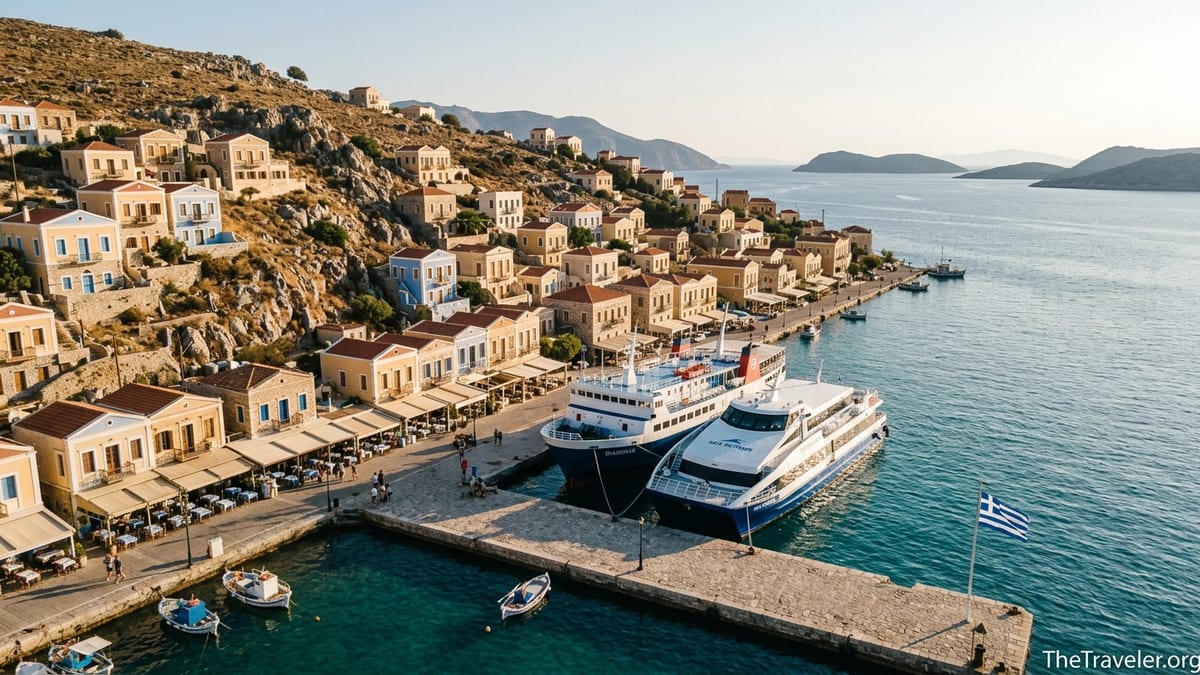
The Dodecanese chain stretches down Greece’s southeast Aegean, from Patmos and Leros in the north to Rhodes and Kastellorizo near the Turkish coast. Unlike some Greek regions where routes radiate almost entirely from Athens, the Dodecanese works on a spine of ferries linking Rhodes, Kos, Kalymnos, Leros, Lipsi and Patmos, with smaller islands like Symi, Tilos, Nisyros, Halki and Kastellorizo branching off. That structure makes it relatively easy to visit three or four islands in one trip without always backtracking to Piraeus.
Two companies sit at the heart of most island hopping plans here. Blue Star Ferries operates large conventional ferries on long lines such as Piraeus – Astypalea – Kalymnos – Kos – Nisyros – Tilos – Symi – Rhodes – Kastellorizo, with typical once or twice weekly frequency in shoulder seasons and often more in peak summer. Dodekanisos Seaways runs high-speed catamarans and a smaller ferry that knit together Rhodes, Symi, Tilos, Nisyros, Kos, Kalymnos, Leros, Lipsi, Patmos and as far north as Samos and Ikaria during the main April to October season. These overlapping networks give you both slower, cheaper options and faster, more frequent boats in summer.
The result is real flexibility. You might arrive on a Friday evening Blue Star from Piraeus into Rhodes, spend three nights there, then switch to a Dodekanisos catamaran on Monday morning for a one-hour hop to Symi and an onward connection to Kos. Or you can fly directly into Rhodes or Kos from cities like London, Berlin or Athens, treat them strictly as gateways, and spend most of your time on smaller islands like Nisyros or Lipsi. The key is understanding which routes run often, which islands pair naturally and how many nights you need on each.
Rhodes vs Kos as Your Gateway Islands
Most travelers start their Dodecanese island hopping from either Rhodes or Kos. Both have international airports with seasonal direct flights from across Europe, year-round domestic flights from Athens, and frequent summer ferries from Piraeus. Choosing between them shapes the rest of your route, so it is worth looking at their roles carefully.
Rhodes is the largest and most visited island in the Dodecanese. It is a natural base if you want a mix of UNESCO-listed old town, larger resorts and easy connections to smaller neighbors. From Rhodes, there are regular ferries to Symi, Halki, Tilos, Nisyros and Kastellorizo, as well as long-distance routes north through Kos, Kalymnos, Leros and Patmos. In practical terms, this means you can build an itinerary like Rhodes – Symi – Tilos – Nisyros over 10 to 12 days without ever stepping on a flight after you land.
Kos, by contrast, is slightly better placed if you are drawn to the climbing and snorkeling scene of Kalymnos, the laid-back charm of Leros and Lipsi, or pilgrim-minded Patmos. Daily or near-daily ferries in summer connect Kos with Kalymnos and Leros, and you can continue all the way to Lipsi and Patmos using a combination of Blue Star Ferries and Dodekanisos Seaways. A common pattern is to fly into Kos on a Saturday, stay two or three nights, then head north to Kalymnos and Leros for four or five days combined, finishing in Patmos before looping back south or flying out from Kos again.
If your flights are fixed into one gateway, you can still design a linear route between them. For example, with an open-jaw ticket arriving on Rhodes and departing from Kos, a two-week route like Rhodes – Symi – Tilos – Nisyros – Kos makes excellent use of the main Blue Star line through the southern Dodecanese. Conversely, if you find cheaper flights both ways to Rhodes, you might design a loop that returns there, such as Rhodes – Symi – Kos – Kalymnos – Rhodes using a mix of Dodekanisos Seaways catamarans and larger ferries.
Core Multi-Island Routes That Actually Work
Although there are dozens of potential combinations on a map, in practice a handful of classic circuits work best with current timetables, especially from late May to late September when routes are most frequent. One of the most popular is the southern mini-circuit: Rhodes – Symi – Tilos – Nisyros – Kos. For example, you might take a morning catamaran from Rhodes to Symi in about 1 hour 20 minutes, spend three nights exploring its neoclassical harbor and beaches, then catch a midweek Blue Star sailing that continues to Tilos and Nisyros overnight or in the early morning. Three nights in Tilos and two in Nisyros give enough time to hike, visit the Nisyros volcano and still keep a relaxed pace before ending with three or four nights in Kos.
For travelers who prefer a quieter, more offbeat focus, a northern route such as Kos – Kalymnos – Leros – Lipsi – Patmos works well. It is realistic to sail Kos to Kalymnos in around 45 minutes, spend three nights, then take a 1 to 1.5 hour ferry to Leros. Two or three nights in Leros allows you to explore Platanos and the island’s Italian-era architecture. From there, summer catamarans run to Lipsi in roughly an hour, and onward to Patmos in another hour, so you can divide a week between Lipsi and Patmos depending on how much time you want for beaches versus historical sites like the Monastery of Saint John.
If you have 15 to 18 nights and want a broader sweep without rushing, you can join both halves of the chain. One workable example is to start in Rhodes, move to Symi for three nights, continue north via a through-ferry to Kos, carry on to Kalymnos and Leros, then finish in Patmos before catching a long Blue Star service back south. In this kind of itinerary, ferries such as the Blue Star Patmos or other scheduled ships that trace the Piraeus – Astypalea – Dodecanese line become your backbone, while Dodekanisos Seaways fills gaps with faster hops. The key is to use the stronger links, like Rhodes – Symi or Kos – Kalymnos, as anchors, then add quieter islands as side branches only when schedules align well.
Ferries, Catamarans and Booking Tickets
The Dodecanese relies on a mix of big overnight ferries, smaller local boats and fast catamarans. On major routes like Piraeus – Kos – Rhodes and the south Dodecanese line that also serves islands such as Nisyros, Tilos, Symi and Kastellorizo, Blue Star Ferries operates large vessels with cabins, garages and multiple lounges. These ships are slower but handle wind better and run in almost all weather conditions. Journey times from Rhodes to Nisyros on such ferries are often between 2 hours 40 minutes and about 3.5 hours depending on intermediate stops, which is comfortable enough to treat them as half-day transfers rather than rushed hops.
Dodekanisos Seaways complements those long-distance ships with high-speed catamarans like Dodekanisos Express and Dodekanisos Pride and a smaller day ferry. These boats link Rhodes with Symi, Tilos, Nisyros, Kos, Kalymnos, Leros, Lipsi, Patmos and sometimes further north. In peak season they often run daily or near-daily, cutting travel times significantly. For instance, Rhodes to Symi can be around 1 hour 20 minutes on a fast catamaran, while Kos to Kalymnos is typically under an hour. However, they are more sensitive to strong winds and may be canceled or adjusted if the Meltemi blows hard in July and August, so it is wise to keep at least some flexibility in your plans.
As for tickets, many travelers now book online through aggregators or directly with ferry companies before arriving in Greece, especially for July and August when cabins and vehicle spaces sell out. For short hops like Rhodes – Symi or Kos – Kalymnos, you can often book just a few days in advance and sometimes even same-day at local agencies around the harbors. Prices fluctuate with vessel type and season, but as a rough guideline, expect around 20 to 45 euros per person for inter-island legs on conventional ferries and somewhat more for high-speed catamarans on popular sectors. Always allow extra time at the port to pick up paper boarding passes when required, and double-check departure piers since large ports like Rhodes and Kos can have multiple gates spread out along the waterfront.
How Many Nights on Each Island and Ideal Trip Lengths
Planning how long to stay on each island is as important as picking the route itself. For most travelers, 10 to 14 nights is the sweet spot for a first Dodecanese island hopping trip. With 10 nights, you can comfortably visit three islands with three to four nights each, plus an extra night at your departure gateway. With 14 nights, four islands at three nights each plus two longer stays become realistic without feeling rushed.
On large and varied islands like Rhodes and Kos, three to five nights work well, especially if you want to mix beaches with cultural sites. For example, in Rhodes you might spend one full day exploring the medieval old town and Palace of the Grand Master, another on a day trip down the coast to Lindos and a third wandering less busy eastern beaches or the interior. Kos similarly rewards at least three nights if you want to combine the main town with cycle paths, Asklepieion and beach runs to Tigaki or Kefalos.
On medium-size islands such as Symi, Kalymnos, Leros, Patmos and Nisyros, two to three nights give a satisfying taste. Symi’s harbor and beaches can be enjoyed in a long weekend. Kalymnos climbers often stay longer, but general visitors find that three nights allow for a boat trip to Telendos and a mix of tavernas around Masouri. Nisyros pairs neatly with Tilos in a four to five night block, giving enough time to visit the volcano, soak in village atmosphere in Mandraki and perhaps rent a car for a half-day coastal loop.
Very small or particularly quiet islands such as Lipsi, Halki and Kastellorizo reward those willing to slow down. Two nights can be enough if you are simply stopping between larger islands, but many repeat visitors choose four or five nights precisely because there is not a long checklist of sights. If you have two weeks, a balanced plan might be: four nights Rhodes, three nights Symi, two nights Tilos, two nights Nisyros and three nights Kos, or alternatively three nights Kos, three Kalymnos, three Leros and five split between Lipsi and Patmos.
Practical Tips: Travel Days, Luggage and Route Direction
When island hopping the Dodecanese, treat ferry days as travel days and keep itineraries realistic. Even if a leg like Kos to Kalymnos is less than an hour, check-in, boarding and sailing can take the better part of a morning. Avoid booking tight same-day connections with flights or onward ferries. As a rule of thumb, do not plan any critical flights less than six hours after a ferry arrival, particularly in July and August when strong winds can delay fast boats.
Luggage is straightforward, but smart packing makes a big difference. On most ferries, passengers with suitcases either carry them to designated luggage racks near stairwells or leave them in a supervised area of the vehicle deck during the crossing. For frequent moves, aim for one main suitcase or large backpack per person plus a small daypack. Wheeled suitcases are common and acceptable, but be prepared to roll them along cobbled harbors in places like Symi and up ramps at busy ports. For catamarans that may require moving quickly at boarding, a slightly smaller, manageable bag that you can lift without help reduces stress.
Route direction matters more than many travelers realize. If you are prone to seasickness or anxious about cancellations, it can be wise to start your route at the more remote end and work gradually closer to a gateway airport. For example, if you plan to end on Rhodes, you might fly into Kos, head north as far as Patmos, then work your way south through Lipsi, Leros, Kalymnos and Kos, and finally take a long ferry to Rhodes. That way, if a sailing is canceled late in the trip, you are not stranded far from an international airport on your departure day.
Whenever possible, build in buffer nights in larger hubs. Spending your final night in Rhodes or Kos before a flight, rather than on a smaller island, greatly reduces the risk of disruption. Many travelers also appreciate scheduling occasional non-travel days, especially after a very early morning or overnight ferry. That could mean simply planning a slow beach day in Kos after a late-arriving Blue Star from Nisyros or scheduling a relaxed harbor-side day in Symi before tackling a long onward journey south or north.
When to Go and How to Keep Plans Flexible
The practical island hopping season in the Dodecanese typically runs from late April through October, with the most frequent routes and greatest choice of sailing times in June, July, August and early September. During these peak months, you will often find daily Rhodes – Symi connections, frequent Kos – Kalymnos – Leros – Lipsi – Patmos catamarans and at least weekly long Blue Star loops through smaller islands like Nisyros, Tilos and Kastellorizo. Shoulder seasons in late April, May and October still have service, but some lines drop to once or twice weekly, which demands more careful planning.
Weather plays a role in how flexible you should be. The Meltemi wind, strongest in July and August, can lead to cancellations or timetable changes for fast catamarans. Conventional ferries are less affected, but it is still sensible to avoid scheduling essential long hops, such as Kastellorizo to Rhodes or Patmos to Kos, on the same day as an international flight. Instead, aim to return to a gateway island at least one day before flying, or even two if you are building complex multi-island routes.
To keep your plans adaptable, consider booking ferries that are hard to replace, such as long overnight segments or once-weekly routes, well in advance, while leaving short hops and hotel reservations on smaller islands a little more open, especially outside August. In practice, this might mean securing a cabin on the Piraeus – Kos – Rhodes Blue Star several months before a July trip, but waiting to commit to particular days between Symi and Tilos until a few weeks out when you can see the most up to date schedules.
The Takeaway
Island hopping in the Dodecanese is as much about smart logistics as it is about sunsets and harbors. With Rhodes and Kos acting as reliable gateways and a dense web of ferries and catamarans linking smaller islands, you can shape a route that matches your travel style, whether that is a three-island loop focused on Symi and Nisyros or a more ambitious north–south sweep reaching Patmos and Kastellorizo.
Give yourself enough time, treat ferry days as part of the experience rather than an afterthought and favor a few well-chosen stops over ticking every name on the map. With a little planning around timetables and buffer days, the Dodecanese rewards you with varied landscapes, distinctive local culture on each island and the pleasure of stepping off a boat into a new port town again and again.
FAQ
Q1. How many islands should I combine on a 10 to 14 day Dodecanese trip
For most travelers, three to four islands work best in 10 to 14 days, such as Rhodes – Symi – Tilos – Nisyros or Kos – Kalymnos – Leros – Patmos.
Q2. Do I need to book all my Dodecanese ferry tickets in advance
It is wise to book long or infrequent routes in advance, especially in July and August, but short hops like Rhodes – Symi or Kos – Kalymnos can often be booked closer to departure.
Q3. Which gateway is better for island hopping, Rhodes or Kos
Rhodes works well for circuits with Symi, Tilos, Nisyros and Kastellorizo, while Kos is better for routes north to Kalymnos, Leros, Lipsi and Patmos; both are good starting points.
Q4. Can I do a one-way island hopping route between Rhodes and Kos
Yes, many routes use Blue Star Ferries and Dodekanisos Seaways to travel one way, for example starting in Rhodes, visiting Symi and Nisyros, and finishing in Kos.
Q5. What is the best time of year for multi-island trips in the Dodecanese
Late May to late September offers the most frequent connections and warm weather, with July and August busiest and shoulder months slightly quieter but still well served.
Q6. How much should I budget for inter-island ferry tickets
Costs vary by route and vessel, but many inter-island legs fall roughly between 20 and 45 euros per person, with high-speed catamarans usually at the higher end.
Q7. Is it practical to island hop with a rental car in the Dodecanese
Some ferries carry vehicles, but fees add up and schedules can limit flexibility, so many visitors rent cars locally on each island instead of taking one car across the whole route.
Q8. What happens if my ferry is canceled due to strong winds
If a ferry is canceled, you are normally rebooked on the next available sailing or refunded; having buffer days and staying flexible with hotel bookings helps reduce disruption.
Q9. Are there luggage limits on Dodecanese ferries and catamarans
Ferries are generally generous with luggage, and passengers routinely travel with large suitcases, but packing light makes boarding and moving around ports much easier.
Q10. Can I island hop in the Dodecanese outside the main summer season
Yes, but services drop in frequency from late October to April, so you should plan fewer islands, check timetables carefully and allow more time between connections.