


I went to Epirus thinking I’d split my time cleanly: a few mountain days for stone villages and gorges, then a quick coastal finish for Ionian swims. Instead, Epirus scrambled my sense of distance and mood. One afternoon I was strolling Ioannina’s lakefront in a blazer-light breeze, watching the castle walls turn honey-colored at sunset. The next night I was white-knuckling a dark, twisting road into Zagori, counting hairpin bends and wondering why my “short drive” had quietly doubled. And by the end, I was floating in that unmistakable Ionian blue near Parga and Syvota, sun-drunk and salty, feeling like I’d traveled to a completely different country without ever leaving one region.
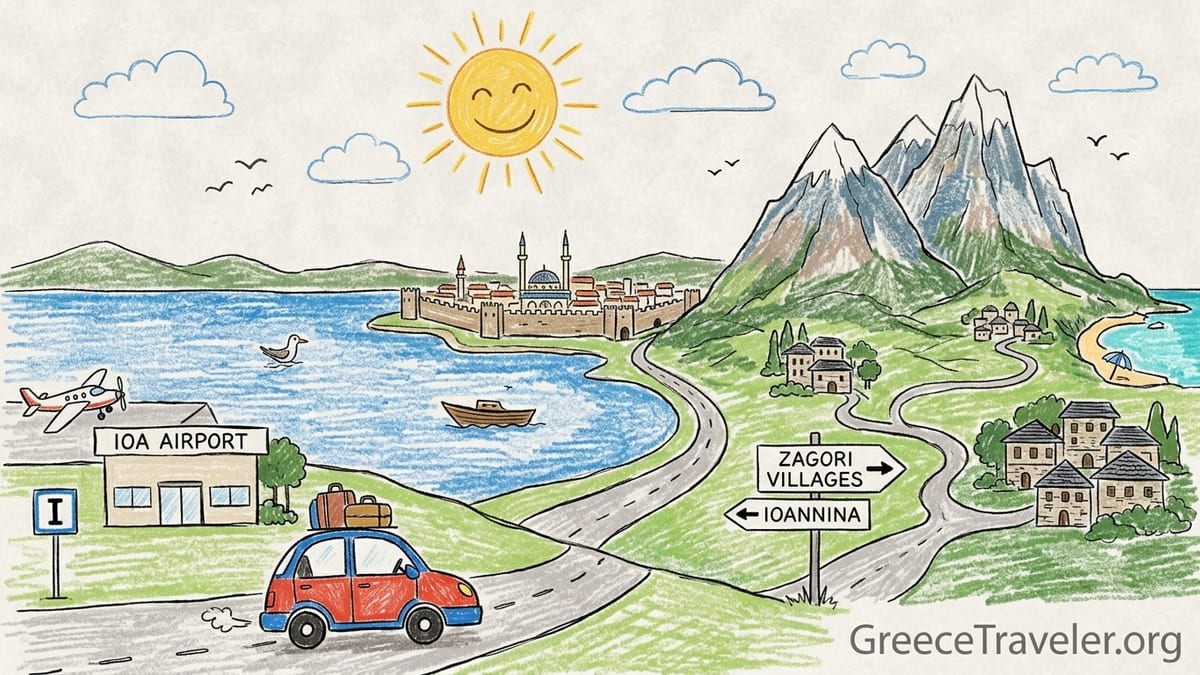
Arriving In Epirus: Ioannina Airport, My Rental Car, And Why The First 4 Kilometers Matter
I flew into Ioannina National Airport (IOA), officially “King Pyrros,” and the first surprise was how close it sits to town. On paper, the airport is roughly 4 kilometers from the city center, but the real lesson is psychological: those first few kilometers set the tone for Epirus. One minute you’re by the runway, the next you’re skirting the lake and thinking, “Wait, I’m already here?” That proximity makes Ioannina an unusually practical base for a region that otherwise rewards patience.
I picked up a rental car right at the airport because I knew I wanted both Zagori and Tzoumerka, and those areas are where a car stops being a convenience and becomes the trip itself. At IOA, I noticed multiple recognizable international brands operating on-site, which simplified logistics after landing. I also clocked the small but functional parking situation: there’s a proper lot with around a couple hundred spaces, so drop-offs and pick-ups didn’t feel chaotic even during busier arrival periods.
Before leaving the airport grounds, I asked two different people about getting into town without a car. The answers were consistent: there is a city bus connection that locals actually use, and taxi rides are generally short and priced like a short urban hop. What I liked about knowing this, even with a rental car, was that it gave me a fail-safe. In Epirus, the roads can be the whole story, and I wanted the option to ditch driving for a day if mountain fatigue set in.
My one early mistake was underestimating how long “easy” days would still feel when I stacked mountains and coast back to back. If I did this again, I’d build in a full rest day in Ioannina at the start or middle, not as a luxury, but as a structural tool to make everything else smoother.
Ioannina: How The City Changed Between Daytime And Evening, And What I Actually Did With One Base
During the day, Ioannina felt like a working city with a traveler-friendly edge: cafés that didn’t mind me lingering, students moving between errands, and a lakefront promenade that made jet lag feel manageable. The light over Lake Pamvotis was soft and silvery in the morning, and I kept getting pulled toward the water even when I meant to go inland. I spent my first hours walking without a plan, letting the city compress my travel brain back into something normal.
Then evening arrived and Ioannina changed outfits. The castle area and lakefront felt more theatrical after dark, with the kind of slow social rhythm that convinces you to order one more drink or one more small plate. I remember noticing how the air cooled quickly once the sun dropped, even in a season that still felt summery in the afternoon. That temperature shift became a recurring Epirus theme: days could be bright and warm, but evenings reminded me I was close to serious mountains.
I used the castle as my anchor, specifically the museum cluster inside it. One of my best practical decisions was checking official museum hours rather than guessing. The Byzantine Museum of Ioannina, inside the castle’s Itch Kale, follows seasonal schedules and closes one day a week, which can ruin an otherwise perfect late-morning plan if you don’t look ahead. I went during the longer summer-style opening window and paid a standard ticket fee, and the experience made Ioannina feel less like a stopover and more like a place with layers.
Food-wise, Ioannina was where I started eating the way Epirus wanted me to eat: slowly, warmly, and with a bias toward pies and dairy. I tried a spinach-and-herb pie first because it looked “safe,” then quickly realized the real local flex is variety. By my second night I was ordering something different each time, including pies stuffed with cheeses that tasted sharper and more mountain-made than what I’d been eating elsewhere in Greece.
Getting Around Without A Car: KTEL Buses, What The Timetables Promised, And What Travel Time Felt Like
I tested KTEL buses on a couple of legs because I wanted to understand Epirus as a planning guide, not only as a road trip. Ioannina’s intercity bus setup is straightforward: the city has a single main intercity station building used by multiple operators, and it’s not in the postcard center, so you plan for a short taxi ride or local bus connection. I appreciated that it felt like a real transport hub rather than a tourist add-on.
The most useful route for many travelers is Ioannina to Parga. The timetable I checked showed multiple departures on weekdays and fewer on Saturdays and Sundays, with an advertised travel time around 1 hour and 45 minutes and a fare in the low teens in euros. That’s the sort of detail that changes your whole itinerary: suddenly you can do mountains first, then swap to the coast without paying for a private transfer.
I also looked up Ioannina to Metsovo by bus because Metsovo is an easy add-on that feels like a shift in altitude and culture. The scheduled duration was under an hour with several departures per day and a fare that made it cheaper than the fuel cost of a solo drive. I didn’t love the idea of hauling luggage onto a bus for a single night, but if I were building a no-car plan, Metsovo would be one of my first mountain picks precisely because it’s so connected.
Here’s what I learned the hard way: even when the KTEL time is accurate, the day doesn’t run on the timetable, it runs on the wait. Waiting for departure, finding the right bay, arriving early because you don’t want to miss it, then walking from the stop to your hotel, all of that adds a soft hour. If I had only one coastal night planned, I’d drive or arrange a private transfer. But for a multi-night coast block, KTEL made sense and felt reliable when I used it.
Zagori: Driving Into Stone Villages After Dark, Parking Reality, And Why Short Transfers Quietly Grew
Zagori is where Epirus stops being “a region you visit” and becomes “a region that tests you.” I drove out of Ioannina toward the Zagori villages in late afternoon, thinking I’d arrive before true darkness. I didn’t. That was my first real scheduling mistake, and it’s one I’m glad I made once rather than repeatedly. Driving into Zagori after dark felt like entering a different map: the road narrowed, my headlights found only the next bend, and the surrounding mountains became a black silhouette that made distance feel larger than it was.
The mountain-road conditions themselves weren’t scary in a horror-movie way, but they were tiring in a practical way. Curves came constantly, and I realized how quickly mental energy drains when you’re alert for stray animals, sharp turns, and occasional oncoming headlights that flare your vision. What surprised me wasn’t danger so much as how long it took to relax. Even after arriving, I needed time to come down from that focus.
Parking was my second Zagori reality check. Many villages have small public parking areas, but “available” doesn’t mean “available when you show up.” When I arrived late, I ended up in the kind of improvised spot that felt acceptable only because it was night and quiet. In the morning, I saw how tight things could get once day-trippers rolled in. If you’re staying in Zagori, I would plan to arrive in daylight and park once, then walk as much as possible.
On the hiking side, I treated the Vikos area as the centerpiece, but I had to choose: viewpoint moments or full-crossing commitment. The classic Monodendri to Vikos crossing is commonly described as a demanding half-day outing that can run around six hours depending on pace and stops, and the park’s own route notes highlight practical details that matter: where to leave the car, when the route is recommended, and how limited water sources can be mid-trail. That “single source” detail stuck in my head. It’s one thing to say “bring water,” and another to realize the trail assumes you’re self-sufficient for long stretches.
I rushed one morning because I wanted to squeeze in both a viewpoint and a longer walk, and that’s the moment I’d restructure on a repeat visit. Zagori deserves an unhurried day. If I went back, I’d pick one big hike and then spend the late afternoon doing the softer pleasures: a long village meal, a slow wander over stone lanes, and an early night so I could start the next day before heat or crowds.
Metsovo: A Softer Mountain Day, Cheese And Smoke, And The Relief Of Easier Roads
After Zagori’s tight bends, Metsovo felt like exhaling. It’s still mountain country, still high enough to make the air feel cleaner, but it’s also a place with an easy rhythm for visitors. I reached it using the main road network that connects Epirus across the Pindus range, and it was immediately less mentally demanding than the smaller village roads. That mattered more than I expected. The relief of not constantly steering through hairpins made me enjoy the scenery more.
I used Metsovo as a food-focused stop, and I’m glad I did. This is where my trip turned into a cheese memory: I ate Metsovone, the local smoked cheese that tastes like the mountains decided to become dairy and then spend time near a fire. I paired it with grilled meat in a taverna setting that felt designed for long lunches. I remember thinking that Metsovo is the ideal “buffer” day in an Epirus itinerary because it restores you while still feeling distinct.
If you’re without a car, Metsovo is one of the easiest mountain places to justify because the bus connections from Ioannina are frequent enough that you can plan a simple day trip. If you do have a car, Metsovo is still valuable because it breaks up the mountain intensity of Zagori and Tzoumerka. It’s not only what you see, it’s how your body feels after a day of driving.
My one regret in Metsovo was not staying overnight. I treated it as a stop, then kept moving, and that was driven by schedule, not wisdom. On a slower return, I’d spend a night, have a long dinner, and wake up to mountain air without needing to immediately chase the next destination.
Tzoumerka: Rivers, Rafting Seasons, And The Mountain Roads That Finally Wore Me Down
Tzoumerka was the part of Epirus that felt least like a postcard and most like a living landscape. The mountains here are dramatic, but it’s the water that defines the day. I built my plan around the Arachthos River, aiming for a rafting run near the Plaka Bridge area, where multiple operators base their routes. I wanted something active, but I also wanted clear safety structure, guides, and proper equipment rather than an improvised thrill.
I booked a guided rafting trip with a well-established operator that outlines its route and duration clearly: around two hours on the river and roughly four hours total for the program once you include kitting up, transfers, and the briefing. The price point I saw for a standard outing started around the €50 mark, which helped me budget realistically. I appreciated the transparency about seasonality too. In Epirus, rafting isn’t a simple “summer-only” activity. It’s tied to rainfall and river levels, and different months can mean different minimum ages and conditions.
Road fatigue hit me hardest in Tzoumerka. Some of the mountain roads here felt like they demanded full attention for longer stretches than I’d planned for, and that’s where my earlier optimism finally caught up with me. I found myself arriving at trailheads or river meeting points already a little tired, which is not how you want to start an active day. One operator even noted that road construction in the area affected routing for a season, and that was a useful reminder: in regions like this, roadworks can change your day more than weather does.
Nature-wise, Tzoumerka gave me my favorite river moments: cold, fast water, green canyon walls, and that sensation that the landscape is not performing for you. It’s simply doing what it has always done. If I were advising someone building an Epirus itinerary, I’d say this: Zagori is the famous headline, but Tzoumerka is where you feel the region’s rawness most strongly.
Parga And Syvota: Ionian Swimming, Boat Days To Paxos, And Why The Coast Felt Like A Different Trip
Dropping from the mountains to the Ionian coast was the most dramatic mood shift of my entire route. In the mountains, my days were structured by daylight, roads, and hiking effort. On the coast around Parga and Syvota, the day reorganized itself around water: where to swim, how to time a boat trip, when the afternoon breeze picked up, and how long it took to find parking near a popular beach.
Parga at night felt like the perfect counterpoint to Zagori after dark. Instead of tight bends and empty roads, I had a lively promenade energy, people lingering late, and that holiday feeling that makes you stop checking the time. I used Parga as my base for beaches, and the beach I returned to repeatedly was Valtos. It’s large enough for a real day on the sand-and-pebble mix, with organized sections and tavernas nearby. But the access is what matters for planning: you can drive to parking near the beach, walk over the headland from town in roughly 20 to 30 minutes, or use a seasonal water taxi from the harbor. In practice, that meant I could adapt to the day’s heat and my own laziness.
Swimming on the Ionian coast was exactly the kind of sensory reset I needed after mountain roads: clear water that made snorkeling feel effortless, a buoyant saltiness, and a different temperature reality than the rivers inland. The sea felt inviting in a way that mountain water often doesn’t. Inland, I loved the rivers, but they could be shock-cold. On the coast, I could actually linger and float instead of doing a quick brave dip.
I took a full-day boat trip from Parga toward Paxos and Antipaxos because it’s one of the signature experiences in this corner of Epirus. The schedules I saw for these cruises were specific: departures in the morning around 10:00 and returns in the early evening, and prices around the mid-€30s in shoulder periods, rising in peak summer. What I want to emphasize is not the itinerary names, but the rhythm. It’s an all-day commitment, and even if it looks like “just a boat ride,” it eats the day the way a mountain hike does. You don’t casually combine it with a long inland drive unless you enjoy exhaustion.
If I were restructuring my own trip, I’d stop doing the coast as an afterthought. Parga and Syvota deserve dedicated time, especially if you want both boat days and quiet swims. I tried to compress too much into my final stretch, and it made me rush meals I should have lingered over. By the end, I realized Epirus is not a region where you win by being efficient. You win by being patient.
The Takeaway
Epirus surprised me because it isn’t one trip. It is at least three: a lake-and-castle city break in Ioannina, a mountain-and-stone world in Zagori and Metsovo, and a salt-and-boat coastline around Parga and Syvota. The transitions are dramatic, and the planning challenge is real: “short” transfers can stretch when roads twist, parking fills, or you simply arrive tired.
If you want one base and minimal stress, I’d build a mountain trip with Ioannina as the hub and choose either Zagori or Tzoumerka as the deep dive, not both. If you want easy days and consistent weather comfort, I’d commit to the coast around Parga and Syvota and add only one inland adventure like the Acheron springs. And if you want the full Epirus contrast, I’d slow down and accept that a great combined itinerary is not a sprint. It’s a sequence: Ioannina to reset, mountains to challenge, coast to recover.
The best thing I did was let Epirus change my expectations. The biggest mistake I made was thinking I could keep my usual travel pace. Next time, I’d drive less per day, arrive in Zagori before dark on purpose, and treat the Ionian coast as its own chapter rather than a last-page epilogue.
FAQ
Q1. Should I fly into Ioannina or into another airport for Epirus?
Flying into Ioannina is the most direct way to start a mainland Epirus itinerary, especially for Ioannina, Zagori, Metsovo, and Tzoumerka.
Q2. Do I need a rental car in Epirus?
If you want Zagori villages, trailheads, and flexible Tzoumerka river days, I found a rental car close to essential. For Ioannina to Parga or Metsovo, KTEL buses can work.
Q3. How reliable are KTEL buses between Ioannina and Parga?
When I checked current timetables, Ioannina to Parga had multiple departures and an advertised duration around 1 hour 45 minutes, but you should still plan extra time for station logistics.
Q4. What did driving into Zagori after dark feel like?
For me it felt tense and tiring rather than dangerous: narrow roads, constant bends, limited lighting, and a lot of concentration. I would plan to arrive before dark.
Q5. Is Vikos Gorge a half-day or full-day hike?
It depends on the route and your pace, but the classic crossing is often treated as a demanding half-day that can take around six hours or more with stops.
Q6. Is Metsovo worth it if I’m already doing Zagori?
Yes, because Metsovo feels like a softer mountain day and a food highlight. It also has practical connections from Ioannina, so it’s easier to add than many villages.
Q7. When is rafting in Tzoumerka available?
Operators run rafting on the Arachthos for much of the year depending on rainfall and conditions, with season-dependent requirements. I confirmed details with the operator I booked.
Q8. What’s the easiest beach base, Parga or Syvota?
Parga is an easy base if you want town atmosphere plus nearby beaches like Valtos and organized day cruises. Syvota is great if you want calmer bays and a boating-focused feel.
Q9. How hard is beach access and parking in Parga?
At popular beaches like Valtos, access is straightforward but parking pressure rises quickly in summer. I used a mix of driving early and walking from town when it was busy.
Q10. If I only have 5 to 7 days, should I do mountains, coast, or both?
If you dislike driving and want easy days, choose the coast. If you want hiking and villages, choose the mountains with Ioannina as a base. If you want both, slow down and split nights rather than day-tripping everything.