


The Ionian Islands run down Greece’s west coast in a chain of green hills, limestone cliffs and sheltered bays that feels very different from the sun-bleached Cyclades. For first-time visitors, the choice between Corfu, Paxos, Lefkada, Kefalonia, Ithaca and Zakynthos is less about ticking off a list of islands and more about matching each island’s distinct personality to the kind of holiday you want, then working out ferries, flights and driving in a way that makes sense in the real world.
How the Ionian Islands Differ from Other Greek Island Groups
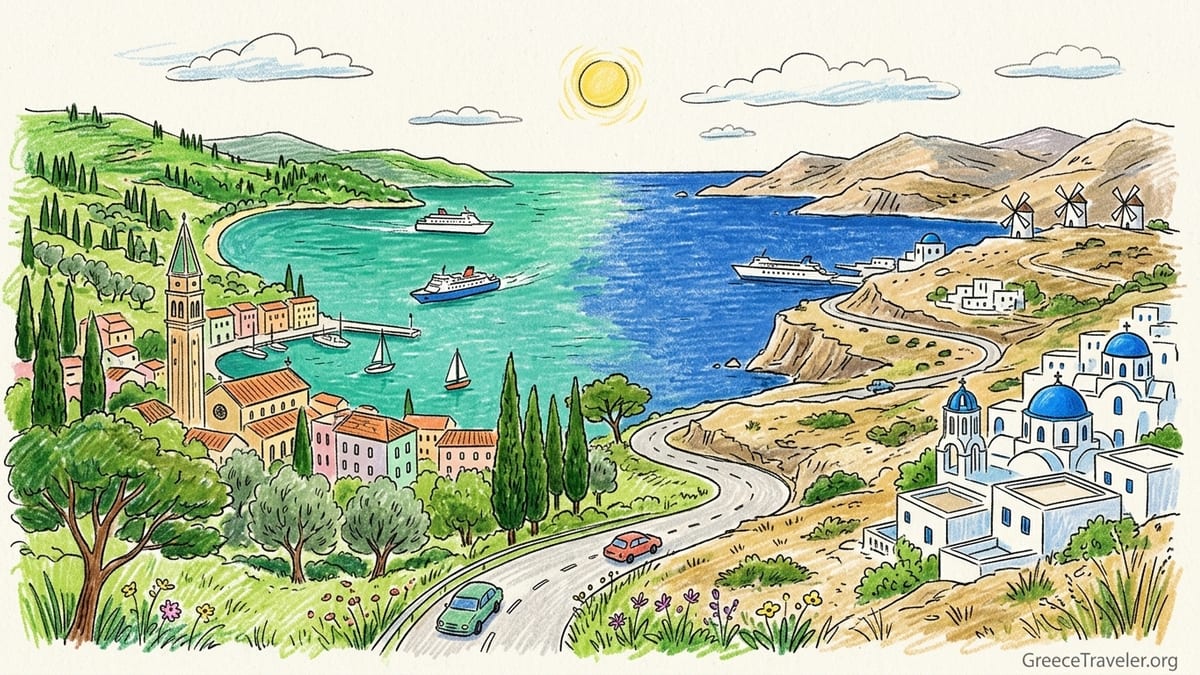
Set between Greece and Italy, the Ionian Sea collects rain and cloud more readily than the Aegean, which is why the Ionian Islands strike most visitors as surprisingly green. Where the Cyclades often show bare rock and white cubes of houses, the Ionians are thick with cypress, olive groves and pine forest, especially on Corfu, Kefalonia and Ithaca. Hillsides are terraced with stone walls and dotted with tall Venetian bell towers rather than the flat-topped blue-domed churches many people associate with Greece.
The climate and geography also shape the sea itself. On the west coasts you find high limestone cliffs and long surfy beaches, such as Porto Katsiki on Lefkada or Myrtos on Kefalonia, while the eastern sides are indented with coves and natural harbours that attract sailors. The water is famously clear and more emerald-turquoise than deep Aegean blue, thanks in part to the forested slopes that frame many bays.
History is another key difference. The Ionians spent centuries under Venetian rule, then French and British control, before joining Greece in the 19th century. That legacy lives in Corfu Town’s pastel facades and arcaded Liston, in Italianate village names like Assos or Fiskardo on Kefalonia, and in dishes such as pastitsada and sofrito that you rarely see in the Dodecanese or Cyclades. This western influence gives the region a subtly different architecture, cuisine and even musical tradition.
Finally, the Ionian is logistically distinct. Instead of a dense ferry web like around Naxos or Paros, you are dealing with long distances, several separate ferry networks and a handful of airports. Corfu, Kefalonia and Zakynthos have their own international airports, while Lefkada is served by Aktion airport near Preveza on the mainland. Paxos and Ithaca are ferry only. Island hopping is certainly possible but requires more planning than simply working your way along an Aegean island chain.
Getting Around: Airports, Ferries, Driving and Sailing
Most international visitors arrive by air. Corfu, Kefalonia and Zakynthos all receive seasonal direct flights from many European cities between roughly April and October, as well as year-round domestic flights from Athens. Lefkada’s gateway is Aktion National Airport near Preveza, about a 25 to 30 minute drive from Lefkada Town, with summer flights from hubs like London, Vienna and Munich alongside domestic links. For Ithaca and Paxos you fly into Kefalonia or Corfu respectively, then continue by ferry.
Ferry patterns in the Ionian change frequently, but a few principles help. Ferries between the islands and mainland ports such as Igoumenitsa, Kyllini and Patras are regular and car friendly. Shorter local routes, like Corfu to Paxos or Lefkada to Kefalonia, may be seasonal and sometimes passenger only. For example, small operators typically run fast boats from Corfu to Gaios on Paxos in under 90 minutes, while services like the Lefkada Palace boat connect Corfu, Paxos, Lefkada, Ithaca, Kefalonia and Zakynthos in summer as a passenger link rather than a car ferry. Schedules can cluster on certain days of the week, so it is wise to build flexibility into your itinerary and avoid tight same-day flight connections.
Driving is one of the best ways to experience these islands, because buses often follow basic north-south spines and run mainly in high season. On larger islands like Corfu, Kefalonia and Lefkada, a small rental car typically starts around the equivalent of 25 to 40 euros per day in May or October and can rise to double that in August. Roads are generally paved but narrow and winding, with frequent hairpins and local drivers who know the bends by heart, so first-time visitors are better off planning shorter driving days and avoiding night-time journeys between unfamiliar villages.
For keen sailors, the Ionian is one of Greece’s classic cruising grounds. The mix of gentle summer winds, sheltered channels and well-equipped marinas around Lefkada, Meganisi and Kefalonia make it popular with flotilla holidays. You will see lines of charter yachts moored stern-to at harbours like Sivota on Lefkada or Frikes on Ithaca on August evenings. If you are not sailing yourself, it still pays to understand this rhythm: villages that feel sleepy at noon may be buzzing by 8pm when the evening flotilla comes in.
Corfu: Grand Venetian Capital and Diverse Coasts
Corfu is the logical entry point for many first-time visitors, with a busy airport close to Corfu Town and frequent ferries from Italy and the Greek mainland. It is also the most varied island in the group. Corfu Town itself feels almost like a small Adriatic city, with a pair of fortresses, tight alleys called kantounia, and elegant arcades filled with cafes. Staying here gives you urban atmosphere, history and easy access to day trips, such as boat excursions to the smaller Diapontia islands or to Paxos and Antipaxos.
North of town, the coast turns into a series of resort areas and traditional villages. Places like Dassia and Gouvia offer mid-range hotels and family-friendly beaches close to town, while Paleokastritsa on the west coast has dramatic headlands, coves for snorkelling and monasteries perched on cliffs. The far northwest around Agios Georgios Pagon and Afionas still feels relatively low-key, with simple studios on the hillside and tavernas overlooking a wide bay popular with paddleboarders.
Corfu’s interior is often overlooked by short-stay visitors. Yet mountain villages such as Lakones, Old Perithia and Sinarades reveal the island’s Venetian stone architecture and rural traditions. Trails on Mount Pantokrator climb through olive groves to views across the channel to Albania. Even in high season you can still find quiet tavernas set back from the main roads where locals linger over Corfiot specialities like pastitsada, a slow-cooked beef or rooster dish in a spiced tomato sauce served over thick pasta.
For many first-time Ionian visitors, Corfu works well as a standalone week combining town, beaches and countryside. It also pairs naturally with tiny Paxos for those willing to add a ferry leg. What it does not do quite as easily is connect by sea directly down the whole island chain, so if your heart is set on seeing Lefkada or Kefalonia you may need to route via the mainland or use seasonal multi-stop boats that run only in summer.
Paxos: Small-Scale Escape and Stone-House Charm
Paxos lies just south of Corfu and feels worlds away in pace and scale. With no airport, arrivals come by boat into harbours like Gaios, Lakka or Loggos. Accommodation is mostly villas, guesthouses and small family-run hotels rather than big resorts. Visitors often stock up at the local supermarket in Gaios, rent a small car or scooter, and settle into a slower rhythm of exploring pebble coves and hillside olive groves.
The coastline is compact yet varied. On the east side, sheltered bays such as those around Lakka offer clear water, pebble beaches and calm anchorage for yachts. On the west side, cliffs are undercut by sea caves accessible by boat excursions that loop down to the islet of Antipaxos, whose Vrika and Voutoumi beaches are famous for pale sand and Caribbean-coloured water. These day boats can be busy in July and August, so it pays to opt for the earliest departures or shoulder-season visits in June or September.
Villages on Paxos maintain a low-rise, stone-house aesthetic, with waterfront tavernas that fill each evening as yachts moor up. Prices for simple waterfront meals tend to be a notch higher than on larger islands, reflecting both the island’s small size and high demand. Expect, for example, to pay a bit more for fresh fish or grilled octopus than you might in a mainland taverna. On the other hand, walking trails across the interior are free and rewarding, linking old cisterns, ruined windmills and viewpoints over the west coast cliffs.
Paxos suits travellers who value tranquillity over nightlife, and who are comfortable working around limited transport. It is ideal as a three to five night add-on to Corfu or as a peaceful base for a week if you are happy with repeated swims in familiar bays. For first-timers who want nightlife, broad sandy beaches or major archaeological sites, other islands in the group may be a better fit.
Lefkada: Road-Linked Island of Clifftop Beaches and Watersports
Lefkada has a unique advantage in the Ionian: it is connected to mainland Greece by a short road bridge near Aktion, so you can arrive entirely by land after a flight to Aktion airport or a drive from Athens. This makes it popular with independent travellers who want the flexibility of a rental car without worrying about putting it on a ferry. Lefkada Town, on the northern tip, is a low-rise place of colourful houses, a marina full of yachts and a string of waterside bars that come alive at night in high season.
The island is best known for its beaches, particularly along the southwest coast. Porto Katsiki, Egremni and Kathisma often appear on lists of Greece’s finest stretches of sand, thanks to their combination of white pebbles or sand, sheer cliffs and electric-blue water. Reaching them involves winding roads and, in some cases, a final descent by steps or path, so planning for a day with plenty of water, sun protection and sensible footwear is essential. In July and August, beach bars rent sunbeds and umbrellas, while in shoulder season you may find large areas of sand almost empty.
On the southeast side, the village of Vasiliki has become a hub for windsurfing and sailing thanks to predictable afternoon breezes in summer. You will find several rental centres lining the beach where beginners can take lessons and experienced surfers hire equipment. Small ferries and excursion boats also run from here to nearby beaches and sometimes across to Fiskardo on Kefalonia, creating an easy gateway for those who want to combine islands.
Lefkada’s inland villages such as Karya and Exanthia offer a very different experience from the coast, with plane-tree-shaded squares, small folklore museums and tavernas serving local dishes like lentils from the nearby islet of Kalamos. For a first-time visitor weighing up options, Lefkada is a strong choice if you want dramatic beaches, a good mix of facilities and the freedom to arrive and depart without relying entirely on ferries.
Kefalonia: Big, Wild Landscapes and Contrasting Coasts
Kefalonia (also written Cephalonia) is the largest of the Ionian Islands and feels it. Distances between its main areas can be significant, and many visitors choose to base themselves in one or two regions rather than trying to cover the entire island. The international airport lies near the capital, Argostoli, which has a harbourfront promenade, museums and a long causeway across the bay where locals stroll each evening. Resorts like Lassi, just to the west, provide classic beach-holiday infrastructure with hotels, apartment complexes and sandy bays.
The island’s most iconic sights are spread out. Myrtos Beach on the northwest coast is a sweeping crescent of white pebbles backed by cliffs; viewed from the road above, it offers one of Greece’s emblematic panoramas. Near Sami on the east coast, Melissani Cave and nearby Drogarati Cave showcase Kefalonia’s karst landscape; visitors take short boat rides on an underground lake where the midday sun creates shafts of light on clear water. These popular attractions can get crowded on cruise ship days, so it helps to visit early or later in the afternoon.
In contrast, northern Kefalonia around Assos and Fiskardo has a softer, more intimate feel. Assos clings to a narrow isthmus below a ruined Venetian castle, while Fiskardo’s harbour is lined with pastel neoclassical houses that largely survived the 1953 earthquake that damaged much of the island. Here you find upmarket restaurants, chic boutiques and a notable yachting scene, especially in July and August, when sailing yachts and motorboats compete for mooring space each evening.
Kefalonia rewards visitors who enjoy exploring by car and do not mind some longer drives. It is an excellent base if you want to add Ithaca as a day trip or short stay, with regular ferries connecting ports such as Sami or Poros to Ithaca’s Pisaetos. First-time visitors who prefer compact, walkable islands may find Kefalonia’s scale a bit daunting, but those who value variety and dramatic scenery will likely consider it a highlight of the Ionian group.
Ithaca: Myth, Quiet Harbours and Slow Travel
Ithaca sits just off Kefalonia’s northeast coast, separated by a narrow channel, and is smaller, quieter and more introspective than its larger neighbour. There is no commercial airport, so access is by ferry, usually from Kefalonia, Lefkada or the mainland port of Astakos. This relative seclusion keeps visitor numbers modest compared with Corfu or Zakynthos, and accommodation leans toward small hotels, rooms to let and villas scattered around the bays.
Vathy, the main town, curves around one of the world’s most sheltered natural harbours, fronted by low pastel buildings, fishing boats and small yachts. From here, roads wind north to villages like Kioni and Frikes, where tavernas line the waterfront and stone houses climb the hills behind. The beaches are mostly small pebble coves such as Gidaki or Filiatro, often accessed by a combination of driving and short walks or by water taxi from Vathy.
Ithaca’s identity is closely tied to Homeric myth. Many visitors are drawn by the idea of Odysseus’ homeland, and you will see references to him in hotel names, boat tours and local museums. In practice, the island’s archaeological sites are low key rather than grand, and the main appeal lies in the atmosphere of quiet continuity: old men mending nets in the shade, children jumping off piers, hiking paths that thread through olive and cypress to viewpoints over the channel.
For first-time Ionian travellers, Ithaca works best in combination with Kefalonia or Lefkada rather than as a standalone destination, unless your priority is pure relaxation and walking. It is ideal for those who want to spend their days reading by the sea, swimming in clear water and exploring a handful of villages, without needing a wide range of nightlife or shopping.
Zakynthos: Iconic Cliffs, Family Resorts and Protected Nature
Zakynthos, often called Zante, sits at the southern end of the core Ionian chain. Its international airport brings in large numbers of package holiday visitors, particularly to the southeast coast around Laganas, Kalamaki and Tsilivi, where you find long sandy beaches lined with hotels, bars and water sports. This makes Zakynthos one of the livelier islands in the group, especially in July and August, when nightlife in places like Laganas runs late into the night.
The island is also home to some of the Ionian’s most photographed scenery. Navagio, or Shipwreck Beach, on the northwest coast has become a global icon, with a rusting ship embedded in white shingle at the base of sheer cliffs. Due to rockfall risk, authorities have in recent years restricted access, at times closing landings on the beach itself and directing visitors instead to viewing platforms on the clifftop and offshore boat trips that keep a safer distance. If seeing Navagio is important to you, it is wise to check the latest safety guidance when planning and to be flexible about whether you experience it from above or from the water.
Elsewhere, the National Marine Park of Zakynthos protects loggerhead sea turtle nesting beaches in Laganas Bay, particularly on islands like Marathonisi and on sections of the main beach. Tour operators now work under stricter guidelines on how close boats can approach turtles and how long they can stay. Choosing smaller, responsible operators and avoiding crowded midday trips can make for a more respectful and enjoyable wildlife experience.
Beyond the busy southeast, the island’s interior and western villages such as Keri, Volimes or Anafonitria offer a different side of Zakynthos, with stone houses, small monasteries and hillside tavernas overlooking the sea. For first-time visitors who want a combination of easy flights, sandy beaches and a wide range of accommodation from simple studios to large all-inclusive hotels, Zakynthos is an obvious candidate. Those seeking quieter atmospheres may still find them by focusing on the north or west coasts and travelling outside peak weeks in August.
Choosing Your Island or Planning an Ionian Island-Hopping Trip
Because the Ionian ferry network is less linear than in other Greek island groups, it helps to think in clusters rather than assuming you will sail smoothly from Corfu all the way down to Zakynthos. In practice, many itineraries either focus on the northern pair of Corfu and Paxos, or on a central-southern combination such as Lefkada, Kefalonia, Ithaca and Zakynthos. Moving between these clusters often involves returning to the mainland or timing your trip around seasonal multi-stop boats.
For a one-island first visit, Corfu and Kefalonia stand out for variety, infrastructure and ease of access, while Lefkada is attractive if you prefer to avoid ferries and enjoy driving exploration. Paxos and Ithaca are better as add-ons once you understand Greek island logistics and know that slower, quieter places suit you. Zakynthos suits travellers who prioritise sandy beaches, family-friendly resorts and nightlife over village-hopping or hiking.
When combining islands, build in practical margins. For example, a two-week trip might split time between Corfu and Paxos with a final night back on Corfu before your flight, or pair Lefkada and Kefalonia with a one or two night detour to Ithaca via local ferries from ports like Vasiliki or Sami. Travellers occasionally attempt ambitious chains such as Corfu to Paxos to Lefkada to Kefalonia to Ithaca to Zakynthos, but schedule changes, limited sailings and passenger-only boats make this kind of end-to-end route better suited to flexible travellers with generous time rather than first-timers on fixed dates.
Costs vary widely depending on season, but a realistic starting point for mid-range travellers outside August might be to budget for accommodation in the region of 80 to 150 euros per night for a double room or small apartment, car hire from around 30 to 50 euros a day, and main-course taverna meals from roughly 10 to 18 euros per person, excluding drinks. Smaller islands with more limited stock such as Paxos can be noticeably pricier, especially for waterfront properties in high summer.
Whatever combination you choose, it is wise to keep at least one overnight buffer before international flights, preferably on the same island as your departure airport. Summer meltemi winds are stronger in the Aegean than in the Ionian, but local weather or mechanical issues can still disrupt ferry schedules. A final night in Corfu Town or Argostoli is a small price to pay for peace of mind if you have long-haul connections the next day.
The Takeaway
The Ionian Islands offer a greener, more Italianate and often more relaxed version of Greek island life than the sun-bleached Cyclades, with deep Venetian roots, sheltered sailing waters and dramatic west-coast cliffs. For first-time visitors, the key is to resist treating Corfu, Paxos, Lefkada, Kefalonia, Ithaca and Zakynthos as interchangeable points on a map and instead lean into what makes each stand out, from Corfu’s urban grace to Paxos’s stone-house seclusion, Lefkada’s road-linked beaches, Kefalonia’s big landscapes, Ithaca’s quiet bays and Zakynthos’s mix of iconic views and family resorts.
Logistics matter more here than in some other island groups. Limited inter-island ferries, a handful of airports and the advantages of having a car on larger islands all shape how your trip will feel. Building an itinerary around natural clusters, allowing for buffers before flights and matching your island choices to your appetite for driving, nightlife, beaches or hiking will go a long way toward ensuring your first Ionian journey is memorable for the right reasons.
Whether you end up watching the sun set behind Porto Katsiki’s cliffs, drifting across Melissani’s underground lake or sharing grilled fish in a waterfront taverna in Kioni, the Ionian Islands reward travellers who slow down, explore a little beyond the obvious and accept that not every ferry will line up perfectly. In return, you get one of Europe’s most atmospheric stretches of coastline, where cypress hills meet clear water and village bells still mark the passing hours.
FAQ
Q1. Which Ionian Island is best for a first-time visitor? Corfu and Kefalonia are often the easiest introductions, thanks to their international airports, range of accommodation, varied beaches and historic towns, while Lefkada suits those who prefer to arrive by road.
Q2. Can I visit several Ionian Islands in one trip? Yes, but it requires planning around ferry schedules and flight times. Many first-timers choose either Corfu plus Paxos, or a central-southern combination such as Lefkada, Kefalonia and Ithaca, sometimes adding Zakynthos if time and connections allow.
Q3. Do I need a car on the Ionian Islands? A car is highly recommended on larger islands like Corfu, Lefkada, Kefalonia and Zakynthos, where public buses are limited outside main routes and seasons. On smaller islands like Paxos and Ithaca, many visitors get by with a combination of walking, taxis and occasional car or scooter rental.
Q4. When is the best time to travel to the Ionian Islands? Late May to June and September to early October usually offer warm weather, swimmable seas and fewer crowds than peak season in late July and August. Spring and autumn also suit hiking and driving more than the hottest weeks of summer.
Q5. How expensive are the Ionian Islands compared with other parts of Greece? Prices are broadly comparable to other popular Greek islands, though small, in-demand places like Paxos can be noticeably pricier for accommodation. Eating in local tavernas and choosing simple apartments rather than full-service hotels helps keep costs moderate.
Q6. Is it easy to reach beaches without a boat? On most islands, many beaches are accessible by road, although some of the most photogenic spots, such as west-coast coves on Lefkada or remote bays on Ithaca, may require a combination of driving, walking and occasional water taxis or small boat rentals.
Q7. Are the Ionian Islands suitable for families with children? Yes. Islands like Corfu, Lefkada, Kefalonia and Zakynthos have plenty of family-friendly resorts, shallow beaches and self-catering apartments. Families often appreciate the green landscapes, relatively calm seas and the option of shorter flights from European hubs in summer.
Q8. What should I know about driving conditions? Roads are generally paved but can be narrow, steep and winding, with occasional livestock or local drivers taking corners quickly. It is sensible to book a small to mid-size car, avoid night driving on unfamiliar routes and allow extra time for journeys between villages.
Q9. Can I rely on card payments everywhere? Card payments are widely accepted in hotels, car rental agencies, supermarkets and many tavernas, especially in busier areas. However, it is wise to carry some cash for small family-run places, beach bars or remote villages where card machines may not always be available or working.
Q10. Is swimming safe and are there strong currents? Swimming is generally safe in designated beach areas, with clear water and mostly gentle conditions in bays and on east coasts. On exposed west-coast beaches, waves and currents can be stronger, so it is important to pay attention to local advice, flags and common-sense precautions, especially with children.