


Mainland Greece is where ancient history, dramatic mountains and low-key beach towns all collide. With good highways, dense archaeological sites and characterful small towns, it is one of Europe’s great road trip destinations. This guide lays out realistic 5, 7, 10 and 14 day itineraries that combine Athens, Delphi, Meteora, the Peloponnese, northern Greece and the coast, with honest driving times and practical planning advice.
How to plan a realistic mainland Greece road trip
Mainland Greece is larger and more mountainous than many visitors expect, so the first step is to be realistic about distances. Athens to Delphi is roughly 180 kilometers, usually just under 3 hours by car depending on traffic. Delphi to Meteora (Kalambaka) is around 230 kilometers and about 3 hours of driving. Athens to Nafplio in the Peloponnese is about 140 kilometers and typically 2 hours on a modern toll motorway, plus a short stretch of regular road. These are non-stop times, so you need to add breaks, fuel and photo stops on top.
Car rental is straightforward at Athens International Airport and central Athens, with small manual cars in high season often starting around 35 to 55 euros per day if booked ahead, and more for automatics or one-way rentals. Many travelers pick up a car the morning they leave Athens so they can explore the capital on foot and avoid parking hassles. Most major archaeological sites have paid parking areas, but overnight street parking in old towns such as Nafplio or Kalambaka can be tight in July and August.
Toll costs are a factor on the main motorways. For example, driving the fastest route from Athens to Meteora via Lamia involves several toll plazas that can add up to roughly 20 to 30 euros one way depending on your exact route. The tradeoff is significantly shorter and safer driving compared with older mountain roads. The Peloponnese’s main arteries, such as the A7 from Corinth to Kalamata, are also tolled but well maintained, which makes connecting destinations like Nafplio, Kalamata, and Olympia efficient on a tight schedule.
Season and time of day matter as much as distance. In August afternoons, the heat at open-air sites like Mycenae or Ancient Olympia can be intense, so many travelers explore from opening time until late morning and again after 5 pm. In shoulder seasons such as late May, June, September and early October, driving is easier, parking more relaxed and coastal towns like Nafplio or Kardamyli feel lived-in rather than overrun.
Core highlights: Athens, Delphi, Meteora and the Peloponnese
Almost every balanced mainland itinerary starts or ends in Athens. Two full days in the capital let you see the Acropolis and Acropolis Museum, stroll Plaka and Monastiraki, and explore either the National Archaeological Museum or the more compact Museum of Cycladic Art. Many visitors choose a centrally located hotel between Syntagma and Monastiraki, where you can walk to most sights and use the metro or taxis for the rest.
From Athens, Delphi is a natural first driving leg. The modern village of Delphi hangs on a hillside above the Gulf of Corinth, with simple guesthouses and mid-range hotels that offer sunset views over olive groves. The archaeological site itself includes the Temple of Apollo, theater and stadium, while the Delphi Archaeological Museum holds the famous Charioteer of Delphi. Travelers often arrive by early afternoon, visit the museum, and then explore the ruins either near sunset or at opening time the next morning before coach tours arrive.
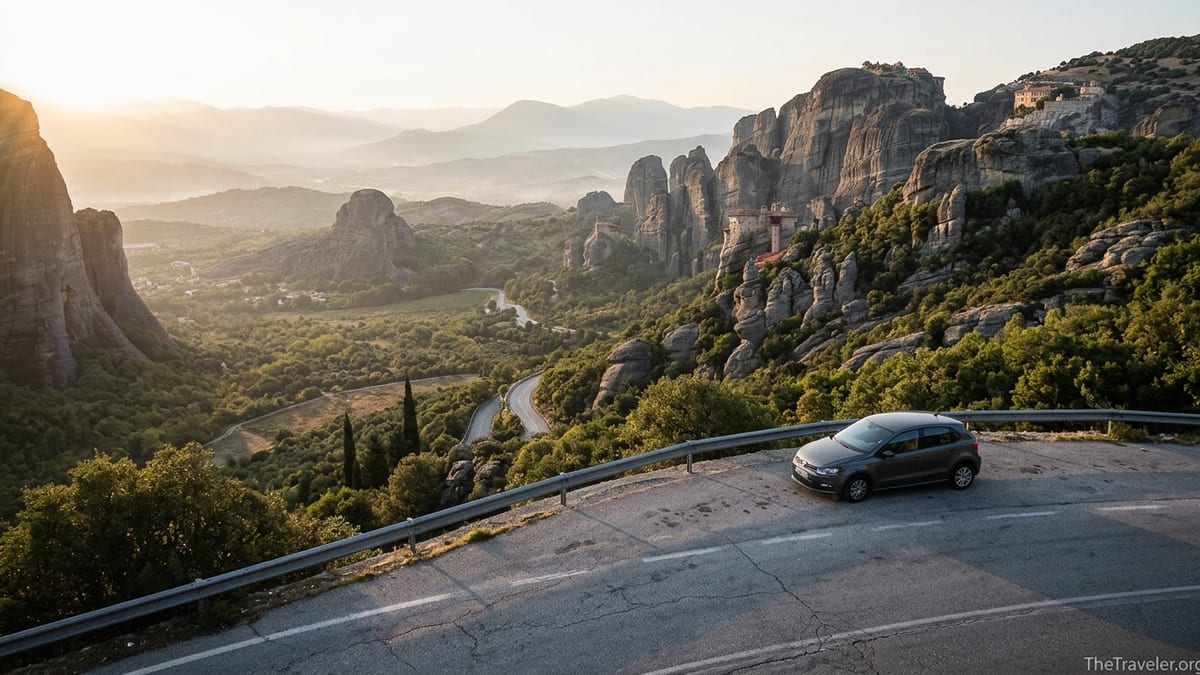
Meteora, in central Greece near the town of Kalambaka and the smaller village of Kastraki, is the second core pillar for a mainland route. Here, monasteries perch on sandstone pillars above the plain, connected by a scenic ring road. With a car, you can spend a day visiting two or three monasteries and stopping at viewpoints, then join a guided sunset tour or an early morning hiking tour the next day. Most itineraries benefit from at least one overnight stay, so you do not have to rush the 3 to 4 hour drive back toward Athens or south toward the Peloponnese.
The Peloponnese is Greece in miniature. Around Nafplio you find the UNESCO-listed theater of Epidaurus and the citadel of Mycenae. In the western Peloponnese lie the ruins of Ancient Olympia. The southeastern coast offers the medieval fortress island of Monemvasia, while the Mani Peninsula around Kardamyli and Areopoli brings stone tower villages and quiet coves. Trying to fit everything into a single week is what exhausts many trips; using the time-based itineraries below will help you choose a coherent slice.
5-day mainland Greece itinerary: Athens, Delphi and Meteora
With only 5 days, focus on Athens plus the Athens–Delphi–Meteora triangle and drop the Peloponnese. One workable structure is two nights in Athens, one in Delphi and one or two nights in Meteora. For example, you might arrive in Athens on Day 1, explore the Acropolis and central neighborhoods, then spend Day 2 on museums and food, perhaps ending with dinner in Psyrri or Koukaki where tavernas stay lively late into the night.
On Day 3, pick up your rental car and drive to Delphi in the morning. Allow around 3 hours of driving plus a coffee stop in the town of Arachova, a fashionable mountain resort with stone-built houses and cafes. Check into a small hotel in Delphi village, visit the museum in the afternoon and walk the ruins in the cooler evening light. Dinner is usually a simple affair at family-run tavernas on the main street, where you can sample dishes like moussaka, grilled lamb chops and salads topped with local feta.
Day 4 is your transfer to Meteora. Plan on about 3 hours of driving via Amfissa and Lamia. Some travelers break the journey with lunch in a roadside grill house, known as a psistaria, where mixed grill platters and Greek salads are inexpensive and portions generous. In Kalambaka or Kastraki, check into a guesthouse and either self-drive the monastery loop or join a late afternoon minibus tour that times visits for quieter periods at the monasteries and iconic viewpoints.
Day 5 is your return to Athens. The fastest drive back is usually via the main motorway past Trikala and Lamia, which can take about 4 to 5 hours depending on traffic and stops. Many people aim for an early start, enjoy breakfast in Meteora with views of the rock pillars, then stop at a motorway service area for fuel, coffee and a quick snack. Plan to reach Athens with enough buffer time for a late afternoon flight or one final evening in the city.
7-day mainland itinerary: adding Nafplio and the Argolid
With 7 days, you can combine Athens, Delphi, Meteora and a taste of the Peloponnese by adding Nafplio and the Argolid region. A typical pattern is to keep 2 nights in Athens at the start, then make a loop: Athens to Delphi, on to Meteora, then drop south via Athens to Nafplio before returning to the capital. This involves several 3 to 4 hour driving legs but remains manageable if you avoid driving at night and share the wheel where possible.
After two nights in Athens, Day 3 still takes you to Delphi, as in the 5 day plan. On Day 4, you continue to Meteora for an overnight, making sure to book accommodation with parking on site. Many guesthouses in Kastraki in particular have small private lots, useful if you are not comfortable squeezing into street spaces. Morning and sunset tours are widely available and let you skip the stress of driving on narrow monastery access roads.
On Day 5, you drive from Meteora back toward Athens and continue into the Peloponnese. The full journey from Kalambaka to Nafplio can take around 6 to 7 hours of active driving depending on which route you choose, so it works best if at least two people can drive. Budget time for breaks at motorway service stations on the way into Athens and another coffee stop around Corinth before turning south toward Nafplio. Once in Nafplio, reward yourself with a seafront stroll, gelato on the promenade and dinner under the plane trees of the old town squares.
Day 6 is a non-driving day based in Nafplio. You can climb the 999 steps of Palamidi Fortress for panoramic Gulf of Argos views, explore the car-free alleys of the old town and, if you want more ruins, make an easy half-day side trip to Epidavros or Mycenae. Both sites are about an hour’s drive from Nafplio; dedicated archaeology fans sometimes do both, but most travelers choose one and spend the rest of their time swimming at nearby Karathona or Arvanitia beaches. On Day 7, you drive back to Athens in about 2 hours for your flight or final overnight.
10-day itinerary: Peloponnese loop with mountains and coast
With 10 days, focus on Athens plus a deeper Peloponnese loop and either Delphi or Meteora, but not necessarily both. One common structure is two nights in Athens, one in Delphi, and then a 7 day Peloponnese circuit through Nafplio, Monemvasia, the Mani Peninsula and Olympia before returning to Athens. This combines major ancient sites with traditional towns and relaxed beach time, and lets you keep most daily drives at 2 to 3.5 hours.
After Athens and a night in Delphi, drive across the Rio–Antirrio bridge toward the western Peloponnese and Ancient Olympia. The drive from Delphi to Olympia is often 3.5 to 4.5 hours depending on stops. Many travelers break it in the coastal town of Nafpaktos for lunch on the harbor and a walk around the Venetian castle. In Olympia, simple guesthouses and mid-range hotels line the main road, and dinners are usually at casual tavernas where set menus with salad, main and dessert offer good value.
From Olympia, you can follow the scenic inland roads or the faster motorway toward Nafplio, stopping at Mycenae or Corinth on the way. Another option is to head directly from Olympia to the Mani region via Kalamata, which is about 3 hours away. The coastal drive from Kalamata to Kardamyli and Areopoli is widely recommended for its sea views and traditional stone villages. A two-night stay in Kardamyli, for instance, allows one day of relaxed beach time and one day exploring Mani’s tower houses around Areopoli and Limeni.
Next, continue east to the fortress town of Monemvasia, often referred to as a Greek Gibraltar because it is set on a rock linked to the mainland by a narrow causeway. The drive from Kardamyli to Monemvasia can take around 3.5 to 4.5 hours depending on your chosen route. Budget at least one overnight within the new town or at a guesthouse perched above the rock. Spend your afternoon and evening exploring the medieval alleyways, churches and sea views, then enjoy a quiet dinner in the old town with fresh fish or simple meze. From Monemvasia, you drive north past Sparta and Tripoli toward Nafplio in roughly 3.5 hours, then finish the loop back to Athens in another 2 hours on mostly motorway.
14-day itinerary: adding northern Greece and mountain towns
With 14 days, you can create an ambitious circuit that combines Athens, Delphi, Meteora, northern mountains and a substantial Peloponnese loop. A typical route starts with two nights in Athens, then heads to Delphi for one night and Meteora for two. From Meteora, you continue north and west to the Pindus mountains, where stone villages like those in the Zagori region offer a different side of Greece, with cool evenings, forest trails and stone bridges.
A three-night base in or around the Zagori villages, for example in the village of Monodendri or Aristi, allows time to hike portions of the Vikos Gorge, drive to viewpoints like Oxya and visit traditional bridges such as Kokkoros Bridge. Driving distances here are shorter but roads are more winding, so a 40 kilometer stretch can easily take over an hour. Overnight temperatures in summer are also several degrees cooler than in Athens or the coast, making it a welcome break from the heat.
From the Pindus region, you can drive east to Thessaloniki in around 3.5 to 4.5 hours and spend two nights enjoying a very different Greek city experience. Here, evenings are centered around the waterfront promenade and neighborhoods like Ladadika, where tavernas, ouzeri and modern bistros sit side by side. History-minded travelers can visit the Rotunda, Byzantine walls and Archaeological Museum of Thessaloniki, while food lovers sample bougatsa pastries, grilled seafood and northern-style meze.
To close the loop, drive south from Thessaloniki toward the Peloponnese, stopping for a final few days in Nafplio and Olympia or focusing on one coastal base such as Kardamyli or Pylos for downtime. For example, you might spend two nights in Nafplio, one night in Olympia and then make the 3.5 to 4.5 hour drive back to Athens via the modern motorways. This kind of 14 day itinerary works best outside peak summer so you are not constantly driving in the highest heat and can find characterful lodging in smaller towns even at short notice.
Driving times, safety and practical tips
Mainland Greece’s longest drives on these itineraries are the 4 to 6 hour links such as Meteora to Nafplio, Delphi to Olympia, or Thessaloniki to the central Peloponnese. On these days, aim to start early, especially in summer, carry water and snacks in the car and schedule at least two proper breaks. Major motorways have service areas every 50 to 80 kilometers with fuel pumps, cafes, toilets and small minimarkets; prices for coffee and snacks are usually slightly higher than in towns but still reasonable by Western European standards.
Speed limits vary between 50 kilometers per hour in towns, 90 on regular rural roads and 120 on motorways, though conditions and signage should always guide your actual speed. Toll booths usually accept both cash and cards, but keeping a small stash of coins and low denomination notes is useful for smaller local tolls and occasional parking fees. When entering villages, look out for zebra crossings and frequent pedestrian activity, especially in the evenings when locals stroll and children play in the main squares.
Parking strategies can make or break a day’s sightseeing. In Athens, many visitors leave the car at a central paid garage and walk or use taxis, which are relatively inexpensive for cross-city journeys compared with many European capitals. In smaller towns such as Delphi, Kalambaka, Nafplio and Olympia, hotels often have their own small parking areas or agreements with nearby lots. Confirm this when booking and factor it into your choice, especially if you are not comfortable maneuvering into tight parallel spaces on steep streets.
Fuel costs fluctuate, but as of mid-2026, petrol in Greece often sits higher than in some neighboring countries, so filling up in larger towns, where competing stations may keep prices slightly lower than on the motorway, can yield modest savings. Many travelers budget a flexible daily driving cost to cover fuel, tolls and parking, then adjust their plans on the ground if they find distances more tiring than expected. Because many scenic detours are easy to add at short notice, it is wise not to lock every night into non-refundable bookings unless you are traveling at the peak of summer.
The Takeaway
Designing a satisfying mainland Greece itinerary is less about ticking every famous name and more about choosing a logical, comfortable route. Even on a 5 day trip, you can combine Athens with Delphi and Meteora without feeling constantly rushed. With a week, adding Nafplio and the Argolid delivers both ancient theatres and relaxed seaside evenings. A 10 day trip opens the door to a proper Peloponnese loop with mountain and coastal towns, while a 14 day journey lets you incorporate the wild mountains of the north and perhaps Thessaloniki as a second city base.
Across all these options, the key is to keep daily driving times honest, remember that mountain and rural roads are slower than they look on the map and factor in heat, season and your own travel style. Plan a handful of anchor stops such as Athens, Delphi, Meteora, Nafplio, Olympia or Monemvasia, then leave some space between them for serendipity: the unplanned coffee in a village square, the extra night in a place that feels right, or the sunset you catch because you did not overpack your day. Mainland Greece rewards this kind of thoughtful, flexible pacing.
FAQ
Q1. Is it safe to drive in mainland Greece for first-time visitors?
Yes, most first-time visitors who are comfortable driving in Europe manage well. Major routes are modern motorways, signage is generally clear in both Greek and Latin script and traffic outside large cities is moderate. The main challenges are narrow village streets, occasional aggressive overtaking by local drivers and adjusting to mountain roads, so avoiding night driving and sharing driving duties helps.
Q2. Do I really need a car for these mainland itineraries?
A car gives you the most flexibility and is the basis for the detailed routes in this guide, but it is not strictly essential. You can reach Delphi, Meteora, Nafplio and Olympia with a combination of intercity buses and organized excursions, at the cost of less spontaneity and more time spent coordinating connections. For travelers uneasy about driving, it can work to use public transport for the long legs and hire local taxis or tours for day trips.
Q3. When is the best time of year for a mainland Greece road trip?
The most comfortable months for a driving-focused itinerary are late April to early June and September to mid-October. In these periods, temperatures are generally mild for sightseeing, roads and parking areas are less crowded and accommodation prices can be lower than in July and August. Winter can be atmospheric in mountain areas but brings shorter days, colder temperatures and occasional snow-related disruptions in higher regions.
Q4. How much driving per day is realistic on these routes?
Many travelers find that 2 to 3.5 hours of actual driving on a sightseeing day and up to 5 or 6 hours on a pure transit day is a comfortable maximum. This allows time for exploring sites, meals and spontaneous stops without feeling rushed. It is important to note that even if a map suggests a 2.5 hour drive, traffic, roadworks, mountain curves and photo breaks can easily add another hour.
Q5. Can I visit both Delphi and Meteora on a short trip?
Yes, combining Delphi and Meteora works even on a 5 day trip if you keep Athens time to two nights and are comfortable with several 3 to 4 hour driving legs. The key is to stay overnight near the sites rather than attempting them as day trips from Athens, so you can visit in the early morning or late afternoon when temperatures are milder and crowds lighter.
Q6. How do tolls and fuel costs affect the budget?
Tolls on main motorways can add a noticeable amount on longer routes, especially on legs like Athens to Meteora or around the Peloponnese, but they buy time and safer driving conditions. Fuel in Greece is typically priced higher than in some neighboring countries, so many visitors estimate a daily driving budget that covers both tolls and petrol and then adjust once on the ground. Choosing a fuel-efficient car and sharing costs among companions helps keep expenses manageable.
Q7. Do I need to book accommodation in advance along these itineraries?
In July and August, and during major holidays, pre-booking at least your key bases like Meteora, Nafplio or popular mountain villages is highly recommended, as small guesthouses can sell out. In shoulder seasons, you often have more flexibility to adjust on the go, especially in larger towns such as Kalambaka or Kalamata. However, if you have your heart set on specific boutique hotels or view rooms, advance reservations are still wise.
Q8. Is it possible to include beaches without losing too much time driving?
Yes, many of the suggested bases combine sightseeing with nearby beaches. Nafplio has accessible beaches like Arvanitia and Karathona, the Mani Peninsula offers coves around Kardamyli and Stoupa and western Peloponnese towns near Olympia have long sandy stretches. On shorter trips, it is more efficient to add a night in such a dual-purpose base than to divert far out of your way to a separate beach destination.
Q9. What kind of car should I rent for these routes?
For most travelers, a compact car with enough space for passengers and luggage is ideal, as it is easier to maneuver and park in old towns and narrow streets. Manual transmission is common and usually cheaper, while automatics are available at higher daily rates and may sell out in busy periods. Unless you are traveling in winter in high mountain areas, a standard car with good air conditioning and reliable brakes is usually sufficient.
Q10. How do I adapt these itineraries if I arrive or depart from Thessaloniki?
If you fly into Thessaloniki instead of Athens, you can reverse or reshape the longer itineraries. For example, you might start with northern Greece and Meteora, then continue south to Delphi and the Peloponnese before ending in Athens. The key is to keep the same logic of grouping nearby regions, limiting long driving days and building in rest days in pleasant bases like Nafplio, Kardamyli or a Zagori village.