


Northern mainland Greece blends seafront holidays, mountain adventures and world-class archaeology in a compact region that is easy to explore by car. Using Thessaloniki as your hub, you can link Halkidiki’s beaches, Mount Olympus, Meteora’s monasteries and the ancient Macedonian sites of Vergina and Pella into one coherent itinerary that still feels like a holiday, not a checklist. This guide sets out realistic routes, drive times and recommended stays so you can build a trip that suits your pace, budget and interests.
How Long To Spend In Northern Mainland Greece
For most travelers, 7 to 12 days is a comfortable window to experience Northern Greece without rushing. With around one week, you can combine Thessaloniki, a slice of Halkidiki, Mount Olympus and either Vergina and Pella or Meteora. With 10 to 12 days, you can connect almost all the major highlights in a loop that feels logical behind the wheel, including Kavala on the eastern coast and extra time at the beach.
A common pattern for a 7-day trip is 2 nights in Thessaloniki, 2 or 3 nights in Halkidiki and 2 or 3 nights split between Mount Olympus and either Meteora or the Macedonian archaeological sites. If you have 10 to 12 days, add 2 nights near Meteora and 2 nights in Kavala, with a final night back in Thessaloniki before your flight. This sort of pacing allows for lazy breakfasts, swims, and an occasional weather day without blowing up the plan.
Drive times are manageable but not trivial. Thessaloniki to Kassandra in Halkidiki is usually just over 1 hour, while the Sithonia peninsula can be closer to 1.5 to 2 hours depending on traffic. Thessaloniki to Litochoro, gateway to Mount Olympus, averages about 1 hour 20 minutes, and Thessaloniki to Meteora is roughly 2.5 to 3 hours by car or train. Factoring in these realistic travel times when you sketch your itinerary will make the difference between a trip that feels fluid and one that feels like a constant transfer.
Season matters too. June, September and early October are ideal for road trips that aim to mix hiking, history and sea swimming, with warm days, cooler nights and generally lighter traffic than peak August. In July and August, demand pushes up car rental prices out of Thessaloniki and crowds swell on the most popular Halkidiki beaches, so booking accommodation and a vehicle early is important if you are tied to school holidays.
Thessaloniki: Lively Hub Of The North
Thessaloniki is the natural starting and ending point for most northern mainland itineraries, with an international airport, plenty of car rental agencies and a compact center that rewards at least two nights. The waterfront promenade, the White Tower, the Ano Poli (upper town) and the markets around Aristotelous Square give first-time visitors a concentrated taste of the city’s energy in a single day on foot.
Plan to arrive in Thessaloniki, collect your car only when you are ready to leave the city, and use public transport and walking in the meantime. Many hotels in the center charge extra for parking, and you do not need a car to enjoy the cafes around Ladadika, the bars on Valaoritou, or the city’s strong museum line-up, which includes the Archaeological Museum of Thessaloniki and the Museum of Byzantine Culture. A mid-range double room in a central hotel often falls in the range of 90 to 150 euros in shoulder season, rising in peak summer and during large events like the International Film Festival in November.
Thessaloniki also serves as a day-trip base if you prefer not to move hotels too often. Organized small-group excursions or private drivers regularly link the city with Vergina and Pella, Mount Olympus and Litochoro, or even Meteora for very long days. For independent travelers, the highway network out of the city is straightforward, though parking regulations and one-way streets inside Thessaloniki can feel daunting at first. If you are nervous about city driving, one practical tactic is to hire a car from an agency closer to the ring road or airport on the day you leave.
Food is a highlight here, and sampling northern specialties at the start or end of your trip gives context to what you eat elsewhere. Expect grilled meats, seafood from the Thermaic Gulf, and meze spreads anchored by spicy cheese dips like tirokafteri, alongside local wines from nearby Naoussa and Drama. A relaxed dinner for two with wine at a busy taverna will commonly run between 35 and 60 euros depending on location and what you order.
Halkidiki: Beach Time On The Three Peninsulas
Halkidiki lies south of Thessaloniki and forms three peninsulas reaching into the Aegean. Kassandra is the closest and most developed, with resort towns, beach clubs and a lively summer nightlife scene. Sithonia is wilder and more low-key, with pine forests dropping to turquoise coves and a mix of small villages and scattered apartments. The third peninsula, Mount Athos, is a monastic community with limited access, but boat cruises depart from places like Ouranoupoli to view the monasteries from the sea without formal entry permits.
From Thessaloniki, you can reach the first resorts of Kassandra in just over an hour, while central Sithonia is usually around 2 hours’ drive. Many visitors choose to base themselves in a single spot for 3 to 5 nights and explore nearby beaches by car. Expect to pay from around 60 to 80 euros per night in simple studios in June, rising to 150 euros or more for seafront hotels and family suites in August. In practice, that might mean an affordable apartment up the hill plus daily drives to famous stretches like Sani Beach on Kassandra or Kavourotrypes on Sithonia, where you pay a small fee for sunbeds or choose the free sand.
Halkidiki also works well slotted into a wider road trip as a decompression zone. You might, for instance, spend a night in Thessaloniki, then drive to Sithonia for three nights of swimming and slower starts before heading inland to Mount Olympus and Meteora. Day-trip options from Halkidiki include cruises along the Athos coastline, visits to traditional villages deeper in the peninsulas and longer excursions to sites like Vergina or Meteora if you do not mind a very early start and a late return.
Food in Halkidiki skews toward fresh seafood and beachside grills. In resort areas, you will find everything from inexpensive gyros and souvlaki to high-end restaurants inside large hotels. Beach bars often have minimum spends for front-row sunbeds in peak season, commonly around 20 to 40 euros per set, which usually includes drinks or snacks. When planning your days, factor in the long, slow coastal roads and summer parking crunches at the most photogenic coves.
Mount Olympus & Dion: Myth, Mountains And Seaside Villages
Mount Olympus, Greece’s highest peak and mythological home of the gods, rises south of Thessaloniki and is easily combined with either coastal stays in Pieria or inland trips to Meteora and the Macedonian sites. Litochoro, roughly 1 hour 20 minutes from Thessaloniki by car, functions as the main base town, with guesthouses, small hotels and tavernas, while the nearby resort strip around Plaka and Leptokarya provides beachfront accommodation if you want sea swims with mountain views.
You do not need to be a summit-level hiker to enjoy the Olympus region. Shorter walks in the Enipeas Gorge, visits to the old stone village of Palaios Panteleimonas and time at the archaeological site of Dion, where an ancient city and sanctuary sit at the foot of the mountains, all fit easily into a one or two night stay. Guided day hikes are widely available and strongly recommended for more serious routes, especially if you are unfamiliar with alpine weather. Prices for group hikes vary, but many full-day outings start from around 60 to 90 euros per person, including transport from Litochoro and basic equipment.
A realistic pattern within a broader road trip might see you leaving Halkidiki in the morning, arriving in Litochoro around lunchtime and spending the afternoon at Dion or on a short gorge walk. The next day, you might join a guided hike or drive to viewpoints higher on the mountain before continuing inland toward Meteora or north toward Vergina and Pella. The highway connections make these combinations straightforward, but mountain weather can shift fast, so keeping one flexible day in your itinerary helps.
Food and atmosphere around Olympus feel distinctly local. In mountain villages you will find grilled meats, hearty stews and foraged greens, while coastal tavernas along Pieria focus on fish and seafood. In the shoulder seasons of May, June, September and October, evenings can be cool, so pack layers even if you have been on the beach in Halkidiki earlier that week.
Meteora: Cliff-Top Monasteries & Practical Logistics
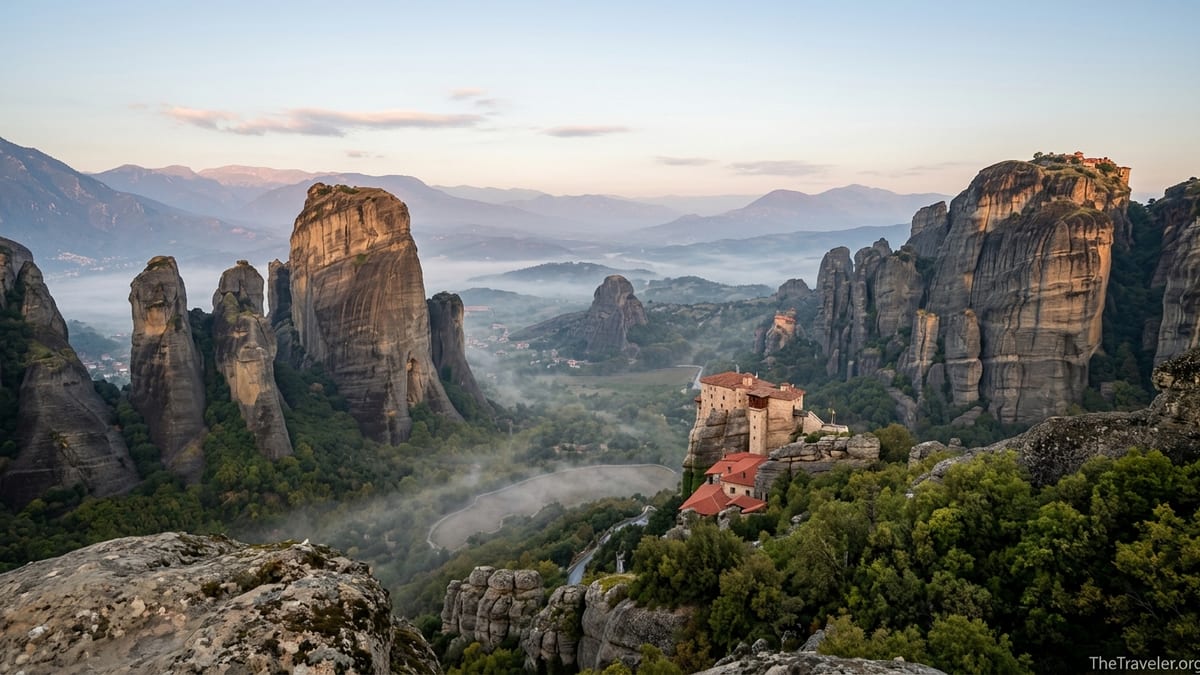
Meteora’s monasteries, perched on giant sandstone pillars near the town of Kalambaka and the village of Kastraki, are one of Greece’s iconic sights and a UNESCO World Heritage Site. From northern mainland bases the most common approach is by car from Thessaloniki or via organized day or overnight tours. Driving from Thessaloniki takes roughly 2.5 to 3 hours on a mix of highway and secondary roads. From Halkidiki, drive times lengthen to around 3.5 to 4.5 hours one way depending on where you start and traffic around Thessaloniki and Larisa, so many travelers prefer an overnight visit rather than a single rushed day.
Two nights at Meteora is ideal if you can spare them, allowing one full day to visit monasteries and an extra half-day for a hike, photo tour or quieter exploration. Many visitors choose a guided sunset tour by minibus on the day they arrive and a separate morning hike or monastery tour the following day. Dress codes require modest clothing: shoulders covered, long skirts for women and long trousers for men in most monasteries, though wrap skirts are often available at the entrances for a small donation.
Budget and mid-range accommodation in Kalambaka and Kastraki usually spans from about 60 to 140 euros per night in shoulder seasons, with some guesthouses booking out months ahead in spring and autumn when hiking conditions are best. Parking at view points and trailheads can be tight at peak times, so starting early in the day or using local tour operators to handle logistics can significantly reduce stress.
Meteora links naturally into wider northern itineraries. One popular loop is Thessaloniki to Vergina and Pella, onward to Meteora for 1 or 2 nights, then across to Mount Olympus and back to Thessaloniki. Another approach from the east is to begin in Kavala, head inland toward Drama or the Macedonian wine areas, then continue to Meteora before swinging north and east again. When you are planning, pay close attention to the total hours behind the wheel between each leg so that Meteora becomes a spiritual and visual highlight rather than a long day of driving with a short view at the top.
Vergina, Pella & Kavala: Macedonian History And Coastal Charm
Vergina and Pella are the twin pillars of ancient Macedonian history in northern Greece and can slot into your road trip either as a focused day trip from Thessaloniki or as stepping stones en route to Meteora or Mount Olympus. Vergina, about 1 to 1.5 hours west of Thessaloniki by car, is known for the Royal Tombs, including the burial of Philip II, father of Alexander the Great, displayed in an underground museum built directly over the excavated site. Pella, about an hour from Thessaloniki, showcases the remains of the ancient Macedonian capital, with remarkably preserved mosaics in situ and in the modern museum.
Many travelers choose to visit both sites in a single loop from Thessaloniki, often starting with Pella in the morning, continuing to Vergina for the museum and a late lunch in the town, then returning to the city by evening. Ticket prices can change, but entry to each site and museum is typically under 20 euros per adult. In summer months, midday heat can be intense on the exposed archaeological grounds, so early starts and hats are advisable. If you are driving between Thessaloniki and Meteora, adding Vergina along the way requires only a modest detour, while Pella sits conveniently on the route between Thessaloniki and some western Macedonian destinations.
Further east along the coast, Kavala offers a blend of sandy city beaches, an old town climbing up to a castle, and ferry links to the island of Thassos. From Thessaloniki, the drive to Kavala takes roughly 2.5 hours on the Egnatia Odos highway. Kavala works well as a 2-night stop in a longer itinerary, particularly for travelers who want coastal scenery and history without returning all the way to Halkidiki. The city’s Ottoman-era aqueduct and tobacco warehouses give it a different architectural character from Thessaloniki, and seafood tavernas along the waterfront are busy on warm evenings.
Combining Vergina, Pella and Kavala into one trip often makes sense for travelers particularly interested in Alexander the Great and Macedonian history. You might, for example, spend 3 nights in Thessaloniki with a day loop to Pella and Vergina, then pick up a rental car for a 2-night stay in Kavala, followed by a longer inland push to Meteora before looping back via Mount Olympus. As you stack sites and cities, make sure that at least every second day has limited driving so you have time to sit in a café and let the history sink in.
Suggested 7–12 Day Road Trip Routes
For a compact 7-day itinerary that still feels rich, one practical route is to start with 2 nights in Thessaloniki, then rent a car and spend 2 or 3 nights in Halkidiki, 1 night near Mount Olympus and 1 or 2 nights at Meteora. On this plan, arrival day in Thessaloniki is for city wandering and recovering from travel. The second day you dive into museums and food, then collect your car on the third morning and drive to Kassandra or Sithonia. After beach time, you drive around 1.5 to 2 hours to Litochoro for an Olympus taster, then continue 2.5 to 3 hours to Kalambaka for Meteora, returning to Thessaloniki by highway for your departure.
If you have around 10 days, you can comfortably add Vergina and Pella plus a stop in Kavala. A realistic 10-day loop might look like this in broad strokes: Days 1 and 2 in Thessaloniki, Day 3 dedicated to a driving loop to Pella and Vergina, Days 4 and 5 in Halkidiki, Day 6 around Mount Olympus and Dion, Days 7 and 8 in Meteora, Day 9 in Kavala and Day 10 returning to Thessaloniki for your last night. This pattern minimizes backtracking and keeps most individual drive segments under 3 hours.
Those with 12 days or more can deepen the experience rather than simply adding more dots to the map. That might mean an extra night in Sithonia to slow down and enjoy smaller coves, a wine-focused day around Naoussa or Drama, or a relaxed third night in Meteora to explore less-visited monasteries and hiking paths. Some travelers also choose to end their trip with two final nights in Thessaloniki to return the car early and enjoy the city’s nightlife and restaurants without worrying about early morning drives.
Whichever length you choose, the most successful northern mainland itineraries tend to limit hotel moves and respect realistic drive times. Instead of trying to see “everything,” choose two or three key themes that matter most to you, such as beaches and mountain hiking, or archaeology and city life, and build a route where each stop clearly serves those priorities.
Driving, Practicalities, Food And Budget Tips
Renting a car in Thessaloniki transforms northern mainland Greece from a list of separate day trips into a coherent road journey. Most international visitors collect their car at Thessaloniki Airport, though city-center agencies can work if you are comfortable driving out through urban traffic. For peak summer dates, booking several months in advance usually secures better prices and car categories. Compact manual cars often start around 30 to 50 euros per day in shoulder seasons, rising higher in July and August, with automatic transmission typically costing extra.
The main highways, including the Egnatia Odos running east toward Kavala and the route south toward Mount Olympus, are modern toll roads. Toll charges add up over a long trip but are generally modest per segment, so keeping some cash or a bank card handy at toll booths is important. Secondary roads into Halkidiki and around Meteora are narrower and slower, but they are also where many of the best viewpoints and small tavernas are found. Parking is free in many small towns and villages but regulated in Thessaloniki and some popular resort centers, so always check local signage.
In terms of daily budget, northern mainland Greece can be more forgiving than the most famous Aegean islands. Coffee and a pastry in a city café often run to 3 to 5 euros, while a simple lunch of souvlaki or a gyros plate might be 8 to 12 euros. At tavernas, shared meze for two with house wine can often land in the 30 to 50 euro range, while more formal dinners at destination restaurants cost more. Museum entrances vary, but many major sites fall between roughly 8 and 20 euros, with combination tickets and seasonal pricing changes, and reduced rates for students and seniors.
Beyond the numbers, plan for the rhythm of Greek daily life. In summer, afternoons can be slow and hot, with many people resting or heading to the beach, and dinners start later than in many northern European countries. Sundays are quieter in city centers but lively in seaside and mountain areas. Keeping a flexible mindset and allowing time for long lunches or impromptu swims will help your itinerary feel more like a northern Greek holiday and less like a logistics exercise.
The Takeaway
Northern mainland Greece rewards travelers who enjoy variety. Within a few hours’ drive of Thessaloniki you can swim off pine-fringed beaches in Halkidiki, walk in the foothills of Mount Olympus, stand before the royal tombs at Vergina and climb monastery steps in Meteora. Kavala adds another coastal flavor, while Pella and Dion deepen the historical tapestry. With realistic drive times, a rented car and a willingness to slow down, you can weave these places into a route that feels both rich and relaxed.
Rather than chasing every possible stop, choose a handful of anchors that speak to your interests, plan 2- and 3-night stays around them, and let the region’s food, landscapes and layered history fill in the gaps. Whether you come for one focused week or stretch to a 12-day loop, the combination of sea, mountains and stories in northern mainland Greece tends to linger long after your trip, inviting you back for the corners you missed the first time.
FAQ
Q1. Do I need a car to follow a Northern Greece itinerary that includes Thessaloniki, Halkidiki, Olympus and Meteora?
You can visit some places by train or organized tour, but renting a car from Thessaloniki makes it much easier to link Halkidiki, Mount Olympus, Vergina, Pella, Meteora and Kavala in one coherent trip and to explore smaller villages, beaches and viewpoints at your own pace.
Q2. How many days do I really need for a Northern Mainland Greece road trip?
A 7-day trip is enough for Thessaloniki, a taste of Halkidiki, Mount Olympus and either Meteora or the Macedonian archaeological sites, while 10 to 12 days lets you add both Meteora and Kavala and build in slower beach or hiking days.
Q3. Is driving in Northern Greece difficult for visitors?
Main highways are modern and well signposted in Greek and Latin script, and most visitors find driving straightforward outside city centers. The trickiest parts tend to be navigating Thessaloniki’s one-way streets and parking, so many travelers collect their car when leaving the city and return it before spending a final night back in town.
Q4. When is the best time of year to combine beaches, hiking and sightseeing in this region?
Late May, June, September and early October usually offer warm but not extreme temperatures, swimmable sea conditions and fewer crowds at sites like Meteora and Vergina. July and August bring hotter weather, busier beaches and higher prices, while winter has fewer services in some coastal areas but can work for city breaks and Meteora if you pack for cold.
Q5. Can I visit Meteora as a day trip from Thessaloniki or Halkidiki?
A long day trip from Thessaloniki is technically possible by car or organized tour, but it involves around 5 to 6 hours of total driving, so many travelers prefer at least one night in Kalambaka or Kastraki. From Halkidiki, the drive is even longer, so overnight stays are strongly recommended if Meteora is a priority.
Q6. How expensive is accommodation around Halkidiki, Olympus, Meteora and Kavala?
Prices vary by season and location, but in shoulder months simple studios and guesthouses often start around 60 to 80 euros per night, while mid-range hotels and seafront rooms commonly run from 90 to 150 euros, with August seeing the highest rates. Booking ahead for weekends and public holidays is wise, especially in popular beach areas and at Meteora.
Q7. Are there any dress codes or cultural considerations I should know for sites like Meteora and Vergina?
At Meteora’s monasteries modest clothing is expected, with covered shoulders and long skirts or trousers, and visitors are often asked to be quiet inside church areas. At archaeological sites like Vergina and Pella regular summer clothing is fine, but hats, sunblock and water are important due to open sun and heat.
Q8. Is Halkidiki suitable for families, and which peninsula is best?
Halkidiki is very popular with families, thanks to shallow sandy beaches and plenty of self-catering accommodation. Kassandra offers the easiest access from Thessaloniki and a wide choice of resorts and organized beaches, while Sithonia is better for families who prefer quieter coves and a more natural setting, with fewer big hotels but many apartments and small campsites.
Q9. How should I split my time between city, beach and mountains on a first trip?
For a balanced first visit, many travelers find that 2 nights in Thessaloniki, 3 or 4 nights in Halkidiki, 1 or 2 nights around Mount Olympus and 1 or 2 nights at Meteora works well, with brief stops at Vergina and Pella slotted into driving days. If you have more time, adding 2 nights in Kavala gives you a second coastal city with a different feel from Thessaloniki.
Q10. Can I combine Northern Mainland Greece with islands in one holiday?
Yes, though you will want to be realistic about travel time. Many visitors pair Thessaloniki and a northern mainland loop with a short stay on an island like Thassos, reached by ferry from near Kavala, or they end the trip with a domestic flight from Thessaloniki to an Aegean or Ionian island. When combining regions, it usually works best to keep at least three nights in each major stop to avoid constant packing and transfers.