


The Peloponnese is one of mainland Greece’s great road trip regions, a peninsula of Venetian forts, Byzantine ghost towns, coastal towers and olive-covered mountains. With good highways from Athens and a growing network of boutique guesthouses, it is easier than ever to link Nafplio, Monemvasia, the Mani peninsula, Kalamata and Olympia into one journey that balances archaeological heavy-hitters with empty beaches and stone-built villages. This guide outlines a realistic regional itinerary, suggested driving routes and trip lengths, plus concrete examples of where to stay and what to expect on the road.
Why the Peloponnese Works So Well as a Road Trip
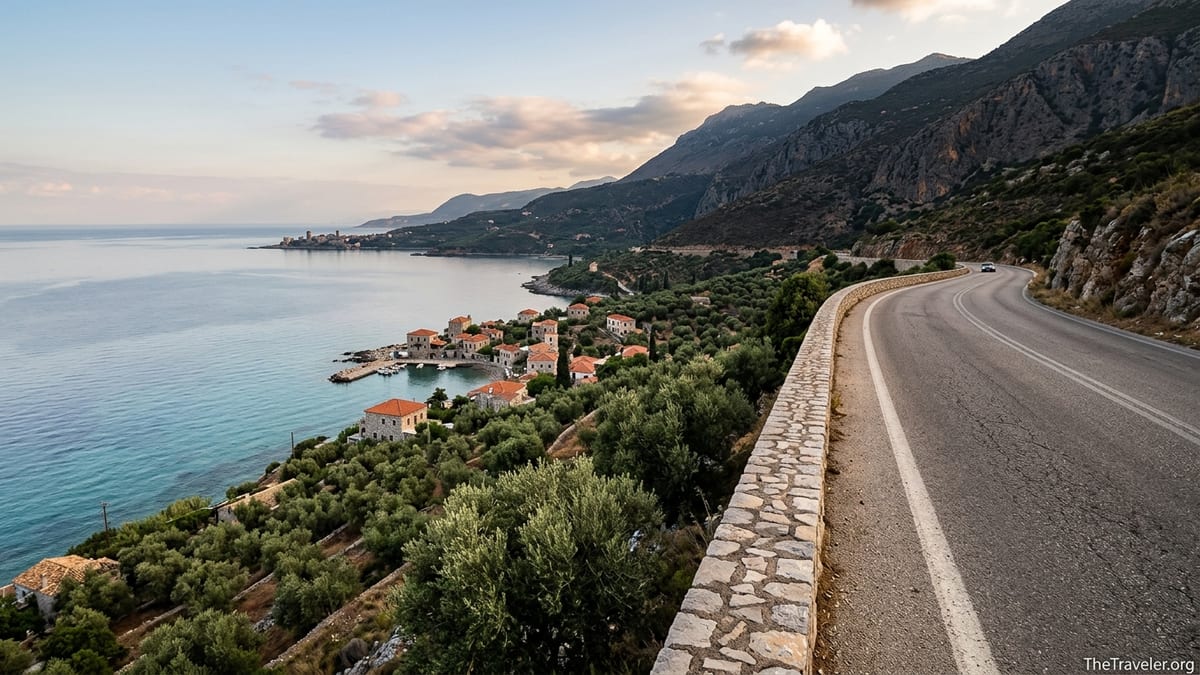
For drivers, the Peloponnese offers a rare combination: modern motorways for the long hauls and twisting scenic roads for the fun bits. From Athens International Airport to Nafplio by rental car is roughly two hours on the A7 motorway and the Corinth–Tripoli highway, mostly dual carriageway with service stations and rest areas. Once you leave the main arteries for places like Monemvasia or the Mani peninsula, speeds drop but the scenery ramps up, with hairpins through olive groves and sea views over the Argolic and Laconian Gulfs.
Distances between the classic stops are manageable. Nafplio to Mycenae is about 25 minutes, Nafplio to Epidaurus around 45 minutes, and Nafplio to Ancient Corinth just over an hour, which makes it realistic to base yourself in one or two towns rather than packing up every day. Longer hops such as Nafplio to Monemvasia or Monemvasia to the villages of the Deep Mani take three to four hours, but can be broken with coastal coffee stops in small places like Leonidio, Gytheio or Gerolimenas.
Infrastructure is improving steadily. Archaeological sites such as Mycenae, Epidaurus and Olympia now operate with standardised opening hours and ticketing policies set nationally, which means most summer visitors can expect extended opening from morning to early evening, and a single ticket covering site and museum in each place. In practice, this allows you to arrive early to avoid the heat and still have most of the day left for driving or swimming.
Compared with the islands, prices remain relatively reasonable. In 2026, mid-range guesthouses in places like Nafplio’s Old Town or stone towers in West Mani villages such as Kardamyli typically run at lower nightly rates than equivalent rooms on popular islands in July and August. Tavernas offering grilled fish, horta and local wine still commonly charge moderate prices for generous portions, especially away from the most touristy seafront strips.
Suggested Itinerary & Recommended Trip Lengths
The Peloponnese rewards time. A compact circuit touching Nafplio, Epidaurus, Mycenae and Olympia can be done in five or six days, but to include Monemvasia, the Mani peninsula and Kalamata without constant packing and long driving days, most travelers will be happier with 10 to 14 days. A common pattern is to fly into Athens, rent a car at the airport, loop clockwise through the Peloponnese and return the car in Athens at the end.
For a one-week trip, focus on the northeast and central Peloponnese. A realistic breakdown could be two or three nights in Nafplio as a base for Mycenae, Epidaurus and Corinth, followed by two nights near Olympia via the mountain villages of Arcadia, and a final night back toward Athens. This keeps most driving days under four hours and still allows for an afternoon swim at beaches around Tolo or Kastro Kyllini.
With 10 days, you can comfortably add Monemvasia and the Mani. One workable route is Athens to Nafplio (2–3 nights), Nafplio to Monemvasia via Leonidio and the coastal road (1–2 nights), Monemvasia to a Mani base such as Kardamyli or Limeni (3 nights), then Mani to Olympia (1–2 nights) before returning toward Athens. This pattern balances two longer driving days with stretches of staying put for hikes, swims and slow breakfasts.
For a full two weeks, many road trippers add both Kalamata and extra time in the central mountains. After Nafplio and the Argolid, spend a night around Dimitsana or Stemnitsa in Arcadia, then continue to Kalamata for two or three nights to enjoy its long city beach, Old Town and easy day trips to West Mani villages like Stoupa. From there, you can dip deeper into the Mani for one or two nights near Areopoli, then curve north to Olympia and finally back to Athens via Patras and the Corinth Canal.
Nafplio, Mycenae, Epidaurus and Corinth: History in Short Hops
Most Peloponnese road trips start in Nafplio, and with good reason. The former capital of modern Greece combines Venetian fortifications with neoclassical mansions and a lively seafront promenade. Choosing a small hotel in the Old Town puts you within walking distance of Syntagma Square’s cafes, the stone-built waterfront and the steps leading up to the Palamidi Fortress, which rewards an early-morning climb with sweeping views over the Argolic Gulf.
From Nafplio, Mycenae is an easy half-day trip. The archaeological site and museum sit on a low hill of yellow rock and olive trees, with the famous Lion Gate and the beehive tomb known as the Treasury of Atreus a short drive or walk away. In summer 2026 the site typically opens from morning until early evening with a single ticket covering both the ruins and the museum, so many travelers aim to arrive soon after opening to avoid the midday sun, then return to Nafplio for a shaded lunch at a backstreet taverna.
Epidaurus, another staple of road trip itineraries, lies about 45 minutes from Nafplio. Its 4th century BC theatre is remarkably intact; even on busy summer days it is still possible to climb to the upper tiers and hear conversations from the orchestra level. If timing aligns, visiting during the Athens Epidaurus Festival in July or August can add the experience of watching a modern performance under the stars, though this requires booking tickets well in advance and driving the winding access roads at night.
Ancient Corinth and the modern Corinth Canal are usually incorporated on the drive from Athens to Nafplio or back again. Although the canal area is dominated by road bridges and viewing platforms, it is a striking place to break the journey, with vertiginous views down to the narrow strip of turquoise water. The archaeological site of Ancient Corinth itself, a few minutes inland, offers a quieter, more spread-out complex of temples, streets and a small museum that is rarely as crowded as Greece’s headline ruins.
Monemvasia and Mystras: Fortified Towns on Rock and Ridge
Monemvasia, on the southeastern coast of the Peloponnese, is one of the most atmospheric medieval towns in Greece. Reached today by a causeway from the mainland, the lower town is a dense knot of stone houses, churches and guesthouses built against a sheer rock face. Cars stay outside the walls in designated parking areas near the bridge, so expect to wheel suitcases over cobbles and up steps. Once you settle into a room with a sea-facing terrace, however, the lack of vehicles inside the walls becomes part of the charm.
From the main alleyways, stepped lanes lead toward the upper town, a ruined acropolis on the plateau above. The climb can be hot and exposed, so many visitors tackle it in the early morning or late afternoon, carrying water and wearing proper footwear for loose stones. Cultural small touches, such as the Yannis Ritsos House Museum tucked inside the old town fabric, underscore Monemvasia’s long connection with Greek literature as well as its Venetian and Byzantine past.
Mystras, often paired with Monemvasia on Peloponnese road trips, lies inland near modern Sparta. Whereas Monemvasia clings to a rock over the sea, Mystras cascades down a steep hillside beneath the Taygetos range, a Byzantine city of churches, palaces and houses gradually being stabilised and restored. The site has separate upper and lower entrances connected by stepped paths; many drivers park first at the upper gate, wander down through ruins and frescoed chapels, then exit at the lower gate and take a taxi or second car back up.
Driving between Monemvasia and Mystras gives a good sense of the interior Peloponnese. Expect a mix of narrow, winding sections and more open valleys, with roadside villages offering simple grill houses and bakeries. For many travelers, a night in or near Mystras breaks the longer journey between the coast and Olympia or the Mani, and allows for an early or late visit when the light is soft on the stone.
Into the Mani and Kalamata: Towers, Coves and Olive Groves
The Mani peninsula feels like a different country inside Greece, with bare hillsides, dry-stone terraces and austere tower houses that once served defensive as much as domestic purposes. West Mani, accessed from Kalamata via Kardamyli and Stoupa, is the softer face of Mani, with more greenery, small resort infrastructure and a mix of pebbly and sandy beaches. Kardamyli, about an hour from Kalamata, combines a small harbor, stone guesthouses and easy access to hiking trails in the Vyros Gorge and the lower slopes of Mount Taygetos.
Stoupa, just south of Kardamyli, has a more overtly holiday feel, with a broad sandy bay lined with tavernas and cafes; for many first-time visitors, it is the easiest place to base for several nights while day-tripping to smaller coves and inland villages. Activities popular in 2026 include guided sea-kayaking along the cliffs, short hikes to tower-house hamlets and boat trips to otherwise inaccessible beaches. Prices for such excursions are comparable to those in other well-visited parts of coastal Greece, with small-group outings typically costing a moderate amount per person.
South of Areopoli, the landscape grows harsher and the stone towers more pronounced. Small coastal places such as Limeni and Gerolimenas consist of only a handful of guesthouses and tavernas, many converted from historic buildings. Roads here are narrow and can be tiring for new drivers, but traffic volumes remain low outside the peak weeks of late July and early August. Some road trippers choose to stay in West Mani and visit the Deep Mani on a long day trip rather than moving accommodation again.
Kalamata itself is more than just a transit point. The city boasts a long shingle and sand beachfront with a promenade of cafes and hotels, an Old Town with a small castle and church-lined streets, and a culinary scene influenced by the surrounding Messinian olive groves. Many itineraries use Kalamata as a practical base for shopping, car rental changes and access to facilities such as laundries, especially on longer trips that combine both Mani and the western coast around Pylos and Costa Navarino.
Olympia, Mountain Villages and Scenic Driving Routes
Ancient Olympia, in the western Peloponnese, anchors the historical side of many road trips. The archaeological site spreads across a green valley of pines and riverside plane trees, with the remains of temples, training facilities and the original running track. Like other major sites, Olympia operates under standardised hours and ticketing, and combination tickets allow access to both the archaeological site and the excellent archaeological museum with its statues and bronzes. Summer afternoons can be very hot, so many visitors aim for an early-morning visit followed by lunch and a siesta at a nearby guesthouse with a garden or pool.
The drive between Olympia and the rest of the route can be as rewarding as the destination. One classic option from Nafplio or Mystras is to weave through the central Peloponnese via the Lousios Gorge and the villages of Dimitsana and Stemnitsa. Here, stone-built guesthouses cluster around small squares, and evenings are cool enough in spring and autumn to justify a fireplace even when the coastal plains are warm. Simple mountain tavernas serve dishes such as slow-cooked lamb, local cheese and foraged greens, often at lower prices than on the coast.
Road surfaces in the interior are variable. While the main regional highways are in good condition, smaller mountain and coastal routes can have potholes, gravel patches and minimal signage. Night driving in these areas is best avoided if possible, especially for visitors unfamiliar with Greek rural roads; most experienced travelers plan their driving blocks for mid-morning or mid-afternoon, leaving the golden hours free for walks and photography.
Those with more time sometimes extend the loop westward from Olympia to the coastal areas of Messinia before heading back toward Athens. Even a single night near Kourouta or Zacharo offers the chance to experience long, sandy Ionian beaches at sunset, before catching the main highway north. However, for travelers on tighter schedules focused on Nafplio, Monemvasia, Mani and Olympia, it usually makes sense to keep this western extension for a future trip.
Practical Tips: Driving, Seasons, Beaches and Accommodation
Driving in the Peloponnese feels manageable for most confident drivers. Rental cars collected at Athens airport avoid city-centre traffic; from there, clear motorway signage points toward Corinth and the Peloponnese. Speed limits are similar to the rest of Greece, with motorways generally allowing higher speeds and regional roads dropping sharply as you pass villages, where speed cameras and local police occasionally enforce limits. Fuel stations are common on main routes, less so in Deep Mani or certain mountain stretches, so topping up when you pass larger towns such as Nafplio, Sparta or Kalamata is wise.
Seasonal conditions shape the experience. July and August are hottest and busiest, with archaeological sites most crowded in late morning and early afternoon. Shoulder months such as late May, June, September and early October usually offer a more comfortable combination of warm seas, open tavernas and quieter roads. In winter, some small coastal hotels and restaurants close, but road trips focused on history and food still work well, especially if you are prepared for rain and cooler temperatures in the mountains.
Beaches along this route vary from the long sandy spits near Tolo or along the Messinian Gulf at Kalamata to tiny coves in Mani reachable only on foot or by boat. Families often favour organized beaches with sunbeds and lifeguards close to towns, while independent travellers seek out unmarked turnoffs that drop to pebbly inlets. In practice, it is easy to mix both styles, swimming at an organized bay one day and a deserted cove the next, all within an hour’s drive of a base town.
Accommodation options now span renovated mansions in Nafplio’s old streets, stone tower houses in Mani villages, small hotels in Monemvasia’s lower town and family-run pensions near Olympia or in Arcadian villages. Booking ahead is strongly advised for August, Easter and long holiday weekends, when Greeks from Athens also head to the Peloponnese. In June and September there is often more flexibility, but desirable small properties with only a handful of rooms can still fill quickly, especially those with on-site parking just outside old town centres.
FAQ
Q1. How many days do I need for a Peloponnese road trip including Nafplio, Monemvasia, Mani and Olympia?
Most travelers should allow at least 10 days to include Nafplio, Monemvasia, the Mani peninsula, Kalamata and Olympia without constant long driving days.
Q2. Is it realistic to visit Mycenae, Epidaurus and Corinth as day trips from Nafplio?
Yes. All three are within about an hour’s drive of Nafplio, so you can comfortably visit each on separate half days while staying based in the town.
Q3. What is the best time of year to drive this Peloponnese itinerary?
Late May, June, September and early October usually offer warm seas, open tavernas, less intense heat and lighter traffic than peak July and August.
Q4. Do I need a 4x4 vehicle for the Mani peninsula and mountain routes?
No. Standard rental cars are fine for the main paved roads, though extra clearance can be helpful on rougher coastal lanes or village access tracks.
Q5. Is parking difficult in Monemvasia and Nafplio?
Cars are kept outside the walled old town in Monemvasia and on the edge of Nafplio’s Old Town, so you may need to walk a few minutes with luggage.
Q6. Can I swim at beaches near every stop on this route?
Yes. There are beaches or swim spots close to Nafplio, Monemvasia, Mani villages, Kalamata and within a short drive of Olympia and the mountain bases.
Q7. Are archaeological sites like Mycenae, Epidaurus and Olympia open daily in summer?
Major sites follow national schedules that typically provide daily opening from morning to early evening in summer, though exact hours can vary slightly.
Q8. Is driving in the Peloponnese suitable for nervous drivers?
Main highways are straightforward, but some coastal and mountain roads are narrow, winding and unfenced, so nervous drivers should plan shorter daily distances.
Q9. How far in advance should I book accommodation in Mani and Monemvasia?
For July, August and major holidays it is wise to book several months ahead, as many desirable guesthouses in Mani and Monemvasia are quite small.
Q10. Can I do this entire itinerary using buses instead of a rental car?
Intercity buses link the main towns, but reaching mountain villages, small beaches and much of the Mani peninsula is far easier and more flexible with a rental car.