


Rhodes is the natural springboard for exploring Greece’s southern Dodecanese, a sun-baked chain of islands stretching toward Turkey and Crete. From here, fast catamarans and classic overnight ferries fan out to smaller islands like Symi, Halki, Tilos and Karpathos, each with its own pace and personality. With a bit of planning, you can turn Rhodes into the hub of a smooth, rewarding island-hopping itinerary rather than just a one-stop beach holiday.
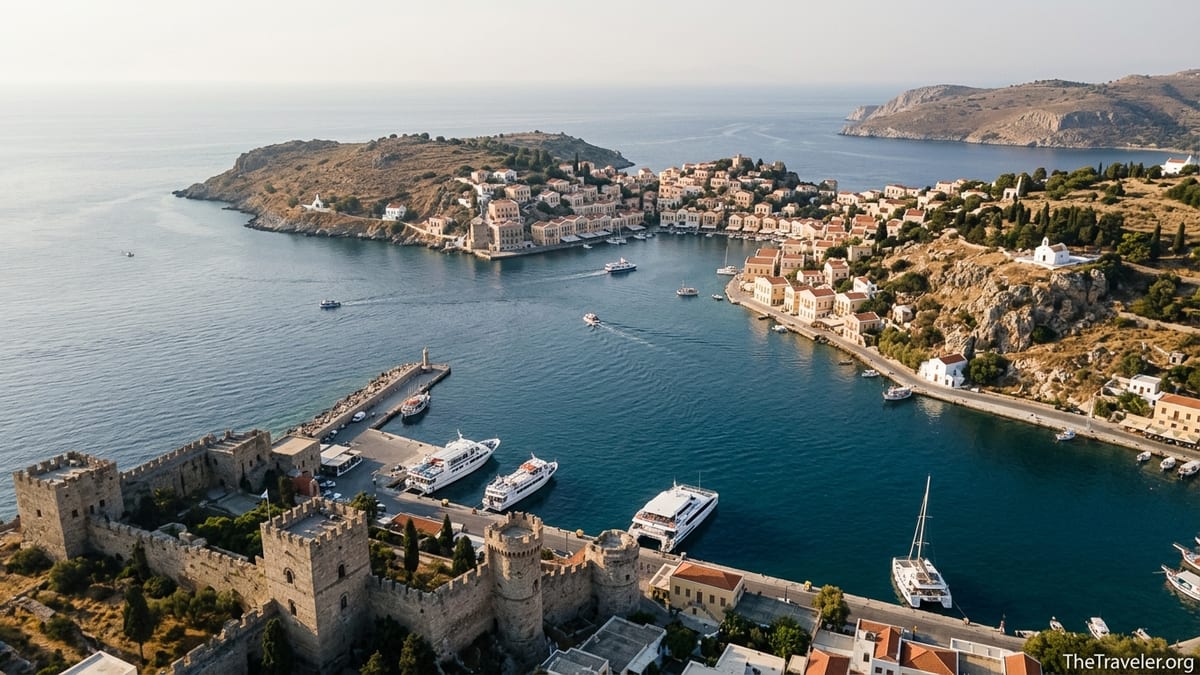
Why Use Rhodes as Your Island-Hopping Hub
Rhodes is the largest and busiest island in the Dodecanese, with an international airport handling frequent summer flights from major European cities as well as domestic connections from Athens and Thessaloniki. That makes it far easier to reach than smaller islands like Tilos or Halki, which rely solely on ferries. For most travelers, flying into Rhodes and then branching out by sea is the most efficient way to start a Dodecanese island-hopping trip.
The main passenger port sits just outside Rhodes Old Town’s medieval walls, within walking distance or a short taxi ride from most city hotels. From here, year-round ferries operated by companies such as Blue Star Ferries link Rhodes with Symi, Tilos and Karpathos, while high-speed catamarans from Dodekanisos Seaways add more frequent and faster summer sailings to Symi and Halki and other islands. These regular services mean you can usually move between islands on most days in peak season, especially from June to early September, although shoulder-season schedules are thinner and require more flexibility.
Rhodes also has the widest choice of accommodation, from budget guesthouses in the New Town to boutique properties in the Old Town and full-scale resorts in Ialyssos and Faliraki. Many travelers treat Rhodes as their base, spending a night or two on arrival to adjust, then heading out to quieter islands, and finally returning for a last night near the airport before flying home. In practice, this approach offers extra insurance against ferry delays or weather cancellations because you are already close to your departure airport.
In terms of costs, ferry tickets from Rhodes to nearby islands often start from roughly 15 to 25 euros one way for standard economy seats on slower ferries, with high-speed catamarans typically more expensive. Booking platforms and local travel agencies in Rhodes Town display up-to-date prices and availability, and in summer it is wise to buy key legs, such as Rhodes to Karpathos, a few weeks ahead if you are traveling on fixed dates.
Key Ferry Routes From Rhodes: What to Expect
Most island-hopping itineraries in this part of the Dodecanese rely on a mix of large conventional ferries and faster catamarans. Blue Star Ferries operates a long north–south line that usually links Piraeus and several Dodecanese islands, including Symi, Tilos, Rhodes, Kasos and Karpathos, on selected days of the week. On these ships, the Rhodes to Symi leg typically takes around 1 hour and 30 minutes, while Rhodes to Tilos is closer to 2 to 3 hours depending on stops, and Rhodes to Karpathos often runs around 4.5 to 5.5 hours in normal conditions according to recent timetables.
Dodekanisos Seaways focuses on high-speed catamarans like Dodekanisos Express that shuttle between Rhodes and smaller islands. For example, recent schedules have shown Rhodes to Symi runs as quick as about 50 minutes on a morning catamaran, while Rhodes to Halki is often around 1 hour 10 to 2 hours depending on the route and intermediate stops. These boats offer allocated seating and modern interiors but are more sensitive to rough seas, which can matter if you are prone to seasickness.
In peak summer, there are often multiple daily connections between Rhodes and Symi, including conventional ferries, catamarans and independent day-trip excursion boats promoted by local agents around Mandraki Harbour. By contrast, islands like Halki and Tilos may only see a direct ferry from Rhodes once a day or even just several times per week, so they require your itinerary to fit the ship, not the other way around. To keep plans realistic, assume that in July and August you will generally find at least one useful connection most days to Symi and often several per week to Halki, Tilos and Karpathos, but that outside those months you must build around specific sailing days.
For planning, many travelers use aggregator sites or the official Blue Star Ferries and Dodekanisos Seaways websites to see current timetables for their travel year. Schedules typically appear in stages, with high-season details often finalised only a few months beforehand. It is common to check the pattern from the previous year to understand which days of the week a route normally operates, then confirm the exact times again closer to departure when your travel dates approach.
Suggested 7–10 Day Itinerary: Rhodes, Symi, Halki and Tilos
For a first-time visitor wanting a mix of atmosphere, beaches and low-key villages, a week to 10 days is enough to link Rhodes with Symi, Halki and Tilos without feeling rushed. One classic pattern is to spend 2 nights in Rhodes Town, 2 to 3 nights in Symi, 2 nights in Halki and 1 to 2 nights in Tilos, looping back to Rhodes for a final night before flying out. This assumes travel in late spring through early autumn, when ferry frequencies are highest.
Imagine arriving in Rhodes on a Saturday afternoon. You stay two nights in the Old Town, wandering its cobbled streets and perhaps visiting the Palace of the Grand Master on Sunday. On Monday morning, you board a high-speed catamaran to Symi, arriving before lunch after a journey of around 1 hour. You check into a neoclassical waterfront guesthouse in Gialos harbour and spend the afternoon exploring on foot, with dinner at a taverna overlooking the pastel-coloured mansions reflected in the water.
After two full days on Symi, including a boat excursion to beaches like Agios Georgios or Nanou and a bus ride up to the hilltop village of Chorio, you continue to Halki. A practical option is to sail back via Rhodes if the direct Symi to Halki connection does not fit your dates, which is common. In that case you might leave Symi on a morning ferry, spend a few afternoon hours in Rhodes Town storing your luggage at a locker service or hotel, then take an evening sailing to Halki, arriving in time for a sunset swim near Nimborio. Because Halki has limited accommodation, many visitors book small family-run rooms months ahead for July and August.
From Halki, your next hop is usually to Tilos via Rhodes, although on some days there may be direct or one-stop routes depending on the broader Dodecanese schedule. Realistically, you should expect to go back through Rhodes and use it as a transfer hub. A typical sequence might involve a morning departure from Halki to Rhodes, a layover of several hours, then an evening Blue Star ferry from Rhodes to Tilos lasting around 2 to 3 hours. In Tilos you can base yourself in Livadia, the main port village, renting a scooter to visit quieter spots like Eristos beach and the abandoned village of Mikro Chorio.
Extending Your Trip to Karpathos and Beyond
If you have 10 to 14 days or want a wilder, more remote-feeling island, Karpathos is a natural extension to a Rhodes-based itinerary. The island sits southeast of Rhodes on the same Blue Star Ferries line that links multiple Dodecanese islands. Typical summer crossings from Rhodes to Karpathos take roughly 4.5 to 5.5 hours on large overnight-style ferries. Sailings often happen only a few times per week, sometimes overnight or at off-peak hours, so your dates must align with the ferry days.
Many travelers choose to end their island-hopping in Karpathos and fly back to Athens from there, as the island has a small airport with domestic flights. However, if your international ticket is in and out of Rhodes, you can also backtrack by ferry. A sample two-week route could look like this: Rhodes (2 nights), Symi (3 nights), Tilos (3 nights), Karpathos (4 to 5 nights), then an overnight or early-morning return to Rhodes for your flight home. This balances shorter hops at the start with a longer open-sea crossing later in the trip.
On Karpathos, most visitors base themselves around Pigadia, the main port, which offers a choice of hotels, beach apartments and rental agencies. From there you can drive or take local buses to beaches like Kyra Panagia, Apella and Achata, and, with more time, up to the traditional mountain village of Olympos. Renting a car is highly recommended on Karpathos because distances between beaches are longer than on smaller islands like Symi, and public transport is limited outside peak season.
Beyond these core islands, the same ferry lines from Rhodes also reach places such as Nisyros, Kos, Kalymnos, Leros, Lipsi and Patmos. If you are comfortable with longer overnight legs and occasional very early departures, you can string together more complex loops including volcanic Nisyros or monastic Patmos. In practice, most first-time visitors focus on Symi and one or two quieter islands like Halki, Tilos or Karpathos, treating other stops as possible future trips rather than cramming too much into a single itinerary.
Planning Around Schedules, Seasons and Ports
Ferry planning in the Dodecanese is as much about understanding patterns as it is about checking exact departure times. In high season from roughly late June to early September, you can expect at least one daily catamaran or conventional ferry between Rhodes and Symi on most days, plus regular services to Tilos and Karpathos on a several-times-per-week pattern. Halki usually sees fewer connections, often one direct daily sailing or just a handful per week, which is why some travelers combine it with Rhodes in a back-and-forth pattern.
Outside high summer, especially from late September through May, schedules become thinner and more vulnerable to weather disruptions. Strong Meltemi winds in the Aegean can lead to cancellations or delays, particularly for high-speed catamarans. If you must travel in shoulder seasons, build buffer days into your itinerary, avoid planning same-day flight and ferry connections, and consider focusing on just one additional island beyond Rhodes, such as Symi or Tilos, rather than a complex multi-stop route.
Within Rhodes itself, most ferries to Symi, Halki, Tilos and Karpathos depart from the main commercial port areas just north of the Old Town, rather than from smaller marinas where day-cruise boats to local beaches depart. It is important to double-check your departure pier the day before, especially in high summer when multiple ships line the quays. Ticket offices for Blue Star Ferries and Dodekanisos Seaways are located near the port; during busy weeks it is smart to collect your physical boarding passes or e-boarding confirmation early to avoid last-minute queues.
When reading schedules online, pay careful attention to arrival ports as well as island names. Symi, for example, has the main harbour at Gialos plus Panormitis on the south coast, which is served by some catamarans and day trips. Rhodes itself uses different berths for large ferries, day-trip boats and international routes to Turkey. Giving yourself at least an hour between connecting ferries is prudent because ships do not always dock at the same pier and can occasionally arrive late due to sea conditions or loading delays.
Practical Tips: Tickets, Budgets and Overnight Ferries
Ticket prices in this region vary by route, company, season and seat type, but there are some useful benchmarks. Short hops such as Rhodes to Symi or Rhodes to Halki on a conventional ferry can start from roughly 15 to 20 euros one way for an economy deck seat, while high-speed catamarans on the same stretch may cost more, often somewhere around 25 to 35 euros depending on demand and any fuel surcharges. The longer Rhodes to Karpathos sailing might be priced higher again, especially if you choose an airplane-style numbered seat or a simple cabin on an overnight crossing.
Booking strategies depend on when and how you are traveling. If your trip is in July or August and your dates are fixed by work or school holidays, book key long legs like Rhodes to Karpathos or Rhodes to Tilos as soon as timetables are released for your year. For more flexible routes, such as Symi to Rhodes, many travelers buy tickets a few days ahead once in Greece, using local travel agencies in Rhodes Town or directly at ferry company offices near the harbour. Day-trip boats run by local operators to Symi or nearby bays can often be bought the day before, though very popular departures can sell out on peak weekends.
Onboard, conventional ferries typically offer open deck seating, indoor lounges, snack bars and sometimes full-service restaurants. For a daytime Rhodes to Symi trip in good weather, many people choose the open deck for views of the Turkish coastline and the colourful Symi harbour as you arrive. On longer legs like Rhodes to Karpathos, travelers often upgrade to an air-conditioned lounge seat or cabin, particularly if the sailing departs late at night or arrives very early in the morning. If you are on a budget, bringing your own water and light snacks helps keep costs down, as onboard cafés are convenient but not cheap.
For accommodation budgeting, smaller islands such as Symi, Halki and Tilos lean toward mid-range guesthouses and self-catering apartments rather than large resorts. In peak season, a simple double room might be in the region of 70 to 120 euros per night depending on location, facilities and how far ahead you book. Prices can be significantly lower in May, early June or late September. Because these islands have limited beds compared with Rhodes, securing rooms early is just as important as booking the ferries that will take you there.
Sample Island-Hopping Combos From Rhodes
If you prefer concrete routes rather than abstract possibilities, it helps to think in simple clusters that you can realistically complete in a week or two. One popular 7-day cluster is Rhodes and Symi only: arrive in Rhodes, spend two nights exploring the medieval Old Town and nearby beaches, then take a morning catamaran to Symi for four nights, and return to Rhodes the day before your flight. This is ideal if you want a gentle introduction to island-hopping without worrying about multiple ferry legs.
A slightly more ambitious 10-day route could be Rhodes, Symi and Tilos. You might fly into Rhodes, spend one night near the port, then head directly to Symi for three nights. After that, you travel Symi to Rhodes and connect onward to Tilos, spending four nights in Tilos for hiking and quiet beaches, and finally return to Rhodes for a last night before departure. In practice, the middle transfer day might involve a few hours of downtime in Rhodes Town between ferries, which is a good opportunity to revisit the Old Town, have a proper sit-down meal and restock on supplies.
For travelers seeking even more off-the-beaten-path experiences, a 12- to 14-day combination of Rhodes, Halki and Karpathos offers a strong contrast. After a night in Rhodes, sail to Halki for three nights of slow-paced village life and uncrowded coves. Then return to Rhodes and catch a long-distance ferry to Karpathos, where you can rent a car and spend five or six nights exploring. You finish with an overnight or early-morning ferry back to Rhodes or a domestic flight from Karpathos to Athens if that better suits your onward travel plans.
Whatever route you choose, build in at least one buffer night in Rhodes at the end of your trip to protect your flight connection. Weather, strikes and occasional technical issues can disrupt ferry schedules at short notice. By returning to Rhodes a full day before your flight, you greatly reduce the stress of possible cancellations, and you gain an extra evening to enjoy the Old Town’s restaurants and harbourfront promenade.
FAQ
Q1. How far in advance should I book ferries from Rhodes to Symi, Halki, Tilos and Karpathos?
For peak season travel in July and August, it is sensible to book main long-distance legs such as Rhodes to Karpathos and Rhodes to Tilos as soon as your travel dates and that year’s timetables are available. For shorter hops to Symi or Halki, many travelers are comfortable booking one or two weeks ahead, though for specific days or large groups you may still want to secure tickets earlier.
Q2. Can I visit Symi from Rhodes as a day trip, or do I need to stay overnight?
Yes, Symi can be visited on a day trip from Rhodes using fast catamarans or excursion boats that often allow roughly six hours or more on the island. However, staying at least one night lets you experience the harbour and hillside village after the day-trippers leave, which many travelers consider the highlight of Symi.
Q3. Is Halki suitable for travelers without a car?
Halki is compact and has a small main settlement at Nimborio, so it works very well without a car. You can walk to several beaches, use small local boats in high season and rely on occasional taxis or minibuses. For most visitors staying a few days, walking and swimming are the main activities.
Q4. How reliable are ferries in the Dodecanese during summer?
In summer, Dodecanese ferries are generally reliable, but strong winds or occasional technical problems can still cause delays or cancellations. It is wise to avoid same-day ferry and flight connections, follow announcements from your ferry company, and keep one buffer day in Rhodes before international flights.
Q5. Are there night ferries between Rhodes and Karpathos?
Depending on the season and specific timetable, some services between Rhodes and Karpathos may run at night or in the very early morning as part of longer multi-island routes. On these, you can often book an airplane-style seat or a basic cabin if you prefer to sleep more comfortably.
Q6. Do I need to reserve cabins on longer routes or can I just use deck seats?
For short legs like Rhodes to Symi, a deck or lounge seat is usually enough. On longer legs such as Rhodes to Karpathos, you can save money with a standard seat but many travelers choose cabins, particularly on overnight sailings or if they value privacy and better rest.
Q7. Is it better to buy ferry tickets online or through local agencies in Rhodes?
Both methods are widely used. Online booking is convenient for securing space on specific dates and cabins before you travel. Once in Rhodes, local travel agencies and ferry company offices near the port can help with last-minute changes, printed tickets and advice on connections, which is useful if schedules shift.
Q8. Can I island-hop in the Dodecanese outside the main summer season?
You can, but itineraries become more limited. From late September through May there are fewer sailings and some high-speed services stop operating. In shoulder seasons, consider focusing on just one or two islands in addition to Rhodes, and be especially careful to check current schedules before committing to nonrefundable accommodation.
Q9. How much should I budget per day for island-hopping from Rhodes?
Daily budgets vary widely, but many mid-range travelers allow for modest accommodation, meals in tavernas, ferry costs spread across the trip, and occasional car or scooter rentals. Islands like Symi and Karpathos can feel slightly pricier than some mainland destinations, while Halki and Tilos often remain comparatively affordable if you choose simpler lodgings and eat mostly in family-run tavernas.
Q10. Is it possible to visit all four islands Symi, Halki, Tilos and Karpathos in one trip?
Yes, but it works best with at least 12 to 14 days so you are not rushed. A realistic route would start and end in Rhodes, include two or three nights on each island, and allow for schedule patterns that may require passing back through Rhodes between some of the islands.