


When I finally made it to Xanthi Carnival in northern Greece, I did what so many first-timers do: I aimed straight for the legendary final weekend. The Thracian Folklore Festivals and Xanthi Carnival had fascinated me for years, with their blend of music, costumes and Balkan energy, and in 2026 I committed to experiencing the peak. What I found between January 28 and February 23, 2026 was a festival that absolutely lived up to its reputation, but also a final parade weekend that, in my view, crosses the line into overcrowded and punishingly expensive. This is a report from the ground, with real dates, real prices and a critical look at what those famous crowds actually feel like when you are in the middle of them.
How I Planned My 2026 Xanthi Carnival Trip
I visited Xanthi Carnival during its 61st edition in 2026, when the Thracian Folklore Festivals ran from January 28 to February 23. The municipal theme that year was "Xanthi Reloaded" and the official program stretched across nearly four weeks of concerts, folklore evenings, parades and local customs. The city framed it as a full cultural season rather than a single weekend blowout, but travel marketing and social media still pushed everyone toward the last Sunday parade and Clean Monday.
Wanting to see both sides, I split my time between the quieter opening and the peak. I arrived on Thursday, January 29, stayed through the official opening weekend, returned home, then came back again from Friday, February 20 to Monday, February 23 for the night parade, the main Sunday parade and Clean Monday. This allowed me to compare weekday and weekend dynamics with the exact same festival in the same year rather than relying on generic "high season" wisdom.
On my first visit, I based myself centrally at a midrange hotel near Dimokratias Square, paying the equivalent of about 110 to 130 US dollars per night booked a month in advance. For the peak weekend, prices at the same property were quoted closer to 180 to 220 dollars and required multi-night minimums, so I switched strategy and booked a guesthouse outside the city toward the village of Pigadia at about 90 dollars per night, booked roughly ten weeks ahead. That single decision changed my experience of the peak drastically.
Throughout my stay I relied heavily on the official English-language program from the Municipality of Xanthi for daily events and on the municipal culture portal and local news outlets for last-minute changes. That may sound like a boring administrative detail, but as I discovered during the children’s parade fiasco in 2026, those official updates can make or break your day.
Inside the 2026 Program: Music, Folklore and the Parades
The 2026 Thracian Folklore Festivals opened on Wednesday, January 28 with a large-scale concert in Dimokratias Square and the official opening ceremony. Pop star Eleni Foureira headlined the night, and the square filled with teenagers in early carnival costumes, flashing LED headbands and improvised masks. It felt like a big-city concert dropped into a compact provincial town, with fireworks bouncing off the neoclassical facades around the square.
After that, the program unfolded in layers. Weeknight events revolved around folklore evenings in the Municipal Amphitheatre and outdoor parties in the square, with guest folklore groups from Serbia and Cyprus joining local cultural associations. On weekends leading up to the finale there were concerts by artists like Marina Satti, Stavento and Sidarta & Mente Fuerte, each drawing a different crowd, from Greek pop fans to Balkan hip hop followers. Most of these shows were free, paid for by the municipality and sponsors, which made weeknight participation surprisingly affordable if you had already handled accommodation.
The backbone of the festival, though, remained the folklore groups of Xanthi and the wider Thrace region. Dozens of associations marched and danced through the Old Town streets in embroidered costumes, each with its own band of brass, drums or traditional instruments such as gaida and davul. Watching them up close on a quiet weeknight, standing two meters from the musicians in a side alley, was a completely different experience from seeing the same groups rush past in the Sunday parade under confetti and floodlights.
The program built slowly toward the three main processions of 2026: the children’s parade, scheduled for Sunday, February 15; the Saturday night parade on February 21, featuring illuminated floats and party groups; and the Grand Carnival Parade on Sunday, February 22, which stretched from the western entrance of town, down 28is Oktovriou and into the heart of the center before ending in a haze of smoke at the traditional "Tzaros" burning by the Kosynthos River.
When the City Swells: Crowds and the 300,000-Visitor Weekend
On ordinary winter weekends Xanthi is a lively university town of roughly 60,000 residents, give or take the student population. During the final carnival weekend, it becomes something else entirely. Municipal and regional officials speaking to local media talked in 2026 of roughly 300,000 visitors over the three peak days from Friday to Sunday. Even if you treat that as a rounded estimate rather than an audited figure, the impact on a city this size is immediate and enormous.
I felt the change physically from the moment I returned on Friday, February 20. Approaching Xanthi from the Egnatia Odos highway in late afternoon, traffic slowed several kilometers before the main exits. Buses from Thessaloniki and Alexandroupoli arrived full, and the parking areas around the bus station were packed with coaches from Bulgarian, Turkish and Balkan tour operators. Local police had implemented traffic diversions and partial road closures already for the night parade build-up, which meant that simply getting to my guesthouse on the outskirts required patience and a willingness to drive a detour through industrial backroads.
In the center, the stated 300,000 visitors translated into shoulder-to-shoulder crowds along the main parade route. On Saturday night, I stood near the junction of 28is Oktovriou and Venizelou about an hour before the night parade began. By the time the first float arrived, I could barely lift my arm high enough to take a photo. The pavements were four to six people deep; children sat on parents’ shoulders; groups from Athens and Kavala formed their own human chains to avoid losing each other as the procession squeezed through narrowed gaps between spectators and cafe terraces.
By Sunday, February 22, every vantage point had been claimed hours before the Grand Parade started. The atmosphere was undeniably electric, with drums echoing between the buildings and confetti drifting over the square, but it came at the cost of any sense of personal space. Moving even one block during the parade meant wading through a slow-moving mass of revelers. For travelers who dislike intense crowds, this is where romantic notions of "joining the locals" collide with the reality of infrastructure stretched to its limits.
Accommodation at Peak Time: What Actually Happens to Prices
One of the most common myths about carnival in general is that hotels simply double their prices. In Xanthi, the picture in 2026 was more nuanced. Using February inventory checks from major booking platforms in late 2025 and early 2026 as a reference, central four-star properties such as Hotel Z Palace & Congress Center showed their highest seasonal rates in February, but the increase compared with non-event winter weekends was more in the range of 40 to 70 percent rather than a clean 100 percent jump. In practical terms, rooms that might sell in mid-January for 120 to 140 dollars drifted toward 190 to 230 dollars for the main carnival weekend, often tied to two or three-night minimum stays.
Three-star city hotels closer to the Old Town followed a similar pattern. In early December 2025, I could still see double rooms for the 2026 carnival weekend around 110 to 130 dollars per night. By mid-January, most central options for February 21 and 22 were either sold out or up to around 150 to 180 dollars, again typically with minimum-stay conditions. Prices did not always look outrageous on paper, but availability was so tight that travelers willing to pay less than about 150 dollars per night inside the city simply faced no realistic options.
On opening weekend, the picture was very different. Staying next to Dimokratias Square on the first days of the festival, with the big Eleni Foureira concert right outside my door, cost about 120 dollars per night for a comfortable double room booked a month out. That was barely higher than a standard winter weekend rate. Pre-opening weekdays, imagine late January Tuesdays and Wednesdays, were even cheaper, with some business-style hotels dipping under 100 dollars per night, especially with early booking.
The most interesting contrast emerged when I looked outside the municipal boundaries. In villages within a 10 to 20 minute drive, such as Pigadia or the road toward Stavroupoli, family-run guesthouses and small hotels still had availability in February 2026 at around 70 to 100 dollars per night, even for the final weekend, as long as you booked by early January. This is not a secret hack that guarantees rock-bottom prices, but in my case, it meant trading a cramped, expensive city room for a quieter countryside base with on-site parking and a breakfast terrace that actually felt like a break from the party.
Road Closures, Parking and the Hidden Cost of Convenience
During my January visit, driving into central Xanthi was straightforward. I could park for free or for a few euros in municipal lots within a short walk of the Old Town and rarely had to think about roadblocks. That changed entirely during the peak weekend. The official program for 2026 included detailed notes on closures and diversions, but it still felt like a constantly shifting puzzle once I arrived, as police adjusted barriers based on crowd flow and parade timings.
On Saturday afternoon, several streets around the parade route were already closed by 15:00, even though the night parade was not scheduled to start until after dark. Drivers circled for half an hour looking for spare spots, with cars from multiple Balkan countries competing for any opening. I eventually abandoned the idea of parking anywhere near the center and used a lot about a 20-minute walk away. It was free, but it came at the cost of trudging back up a hill at 2:30 in the morning after the parties died down, weaving past groups still drinking and chanting.
The Sunday of the Grand Parade was even more challenging. The main road into the city from the west, which doubles as the parade route, was partially or fully closed to regular traffic for much of the day. Buses and organized excursions had pre-assigned drop-off points; everyone else had to improvise. For visitors staying outside the city, this meant leaving the car even further away and accepting a long walk through dense crowds, or arriving very early in the morning before closures kicked in and then waiting hours for the parade to begin.
Public transport helped a little but not much. Local buses operated, yet they too were affected by diversions and delays. Taxis were theoretically an option but in practice almost impossible to find quickly around parade times, and when you did, short rides could cost significantly more than on a normal weekday, partly because drivers had to navigate longer routes to skirt the closed streets. The hidden cost of "being near the action" was the constant negotiation with blocked roads, jammed junctions and long walks at unsociable hours.
Queues, Old Town Congestion and Nightlife Noise
One of the reasons people fall in love with Xanthi is its Old Town, a preserved quarter of mansions, cobbled alleys and tobacco warehouses converted into bars and cultural spaces. During the quieter festival days, you can drift through its lanes, step into the Folklore and Historical Museum, sit for coffee under Ottoman-era balconies and still hear the brass bands playing somewhere in the distance. During the peak weekend, that charm is still there underneath, but it competes with an intensity that caught me off guard.
On Friday, February 20, by about 22:00, the Old Town had turned into a single continuous party. Each cultural association had set up its own "hangout" with food, drink and music pouring into the street. By Saturday night, walking from the lower alleys up toward the Church of Saint Vlassis meant being squeezed between bar terraces lined with people drinking on the steps and impromptu dance circles forming wherever a band decided to stop. It was exhilarating and, at times, borderline claustrophobic.
Restaurant queues were a clear pain point. On my January weekend, I was able to walk into a classic taverna in the Old Town at 21:00 and get a table within ten minutes, paying around 18 to 22 dollars per person for a generous meal of grilled meats, meze and local wine. On the peak Saturday, every comparable restaurant I tried quoted waiting times of 45 to 90 minutes by 20:30. Many had stopped accepting any form of reservation for that weekend, preferring walk-ins from the street. I eventually opted for a souvlaki place off the main lanes, where I still queued on the pavement for more than half an hour and ate standing up at a high table, the only way to keep dinner under 15 dollars and avoid losing two prime viewing hours for the night parade.
Nightlife noise is another trade-off that looks different on the ground than it does in photos. Central hotels, which felt perfectly located during the opening days, were already louder on regular Friday and Saturday nights, with music from bars in the Old Town echoing into the early hours. On the final weekend, that became an almost continuous soundscape of whistles, drums and loudspeakers. Friends who stayed in rooms overlooking central streets reported barely sleeping from Friday through Monday morning, despite shutters and double glazing. My own countryside guesthouse, by contrast, was quiet enough that I could step onto the balcony and hear only distant bass lines from the city, a reminder that choosing peace does not mean missing the party altogether, as long as you are willing to drive in and out.
The Children’s Parade Postponement: Why Official Updates Matter
The clearest example of how fluid the carnival schedule can be came during the 2026 children’s parade. Originally scheduled for Sunday, February 15, this daytime procession was meant to snake through the city center with thousands of schoolchildren in costume. Families from across the region had planned their visit around it, booking one or two nights in Xanthi and timing their travel to catch the Sunday event and maybe a concert in the square.
On the morning of the parade, heavy rain and strong winds hit the city. By mid-morning, the municipality announced that the children’s parade was postponed due to bad weather and would be rescheduled. The decision, reported by local media the same day, was understandable for safety reasons but created immediate confusion among visiting families who had not checked the official channels. I met parents from Komotini and Kavala wandering near the designated gathering area, still hoping it might go ahead because they had heard only rumors and not read the official statements.
Financially, the stakes were not trivial. Many of those families had booked rooms at elevated carnival rates or paid for bus excursions specifically for that day. Some had promised their children the highlight of walking in costume through a cheering city, only to watch them splash through puddles instead. The municipality did reschedule the parade, but for families who could not return to Xanthi on the new date, that offered little comfort.
For me, as an outsider trying to understand how the festival really works, it was a stark lesson. At Xanthi Carnival, you cannot assume that the printed program is fixed. Weather, security assessments and crowd management can all prompt last-minute changes. Relying solely on printed brochures or second-hand online summaries is risky. If you care about specific events like the children’s parade, night parade or Tzaros custom, you need to monitor the municipality’s own announcements or local news channels up to the morning of each event, especially in February when weather swings are common.
Central Stay vs Countryside Base: Two Very Different Carnivals
Having tried both a central hotel and an out-of-town guesthouse in 2026, I can say that Xanthi Carnival effectively becomes two different experiences depending on where you sleep. Staying within walking distance of Dimokratias Square during the opening days meant I could drop into concerts on a whim, slip back to my room to change layers when the temperature fell after sunset, and wander the Old Town late at night without worrying about driving. It also made daytime sightseeing easy. I could spend a morning at the Folklore and Historical Museum, explore the tobacco warehouses and have lunch by the river before heading to an early evening folklore performance.
During the peak weekend, the same central convenience came with serious downsides. Friends staying around the perimeter of the Old Town had to drag their luggage on foot from where taxis were forced to drop them, because roads closest to the center were closed or choked with pedestrians. Their hotels were effectively cut off from vehicular access during key parade hours. When they wanted a break from the noise, there was simply nowhere nearby quiet to go. Cafes outside the absolute core were still packed; parks like Kipseli filled with spillover crowds.
My countryside base, around a 15 to 20 minute drive away, required discipline but felt healthier. I drove into town mid-afternoon on Saturday and Sunday, parked in a lot near the edge of the built-up area before closures tightened, then walked the rest of the way. After the night parade and subsequent parties, I accepted the long walk back through thinning crowds and a late, careful drive on unlit rural roads. In return, I woke up each morning to relative silence, real breakfast and the option of a short daytime walk in nature before plunging back into the festival. The nightly cost was lower, parking was free, and I was spared the permanent noise bath of a central room.
There is no single right answer for everyone, but I came away convinced that if your main goal is to enjoy the final weekend without burning out, a base just outside the city limits offers a better balance between immersion and sanity. If your priority is nightlife and you can tolerate minimal sleep, a central stay might still suit, but make sure you understand that "near the action" at Xanthi Carnival means literally surrounded by it at all hours.
Weekday Magic vs Final Weekend Spectacle
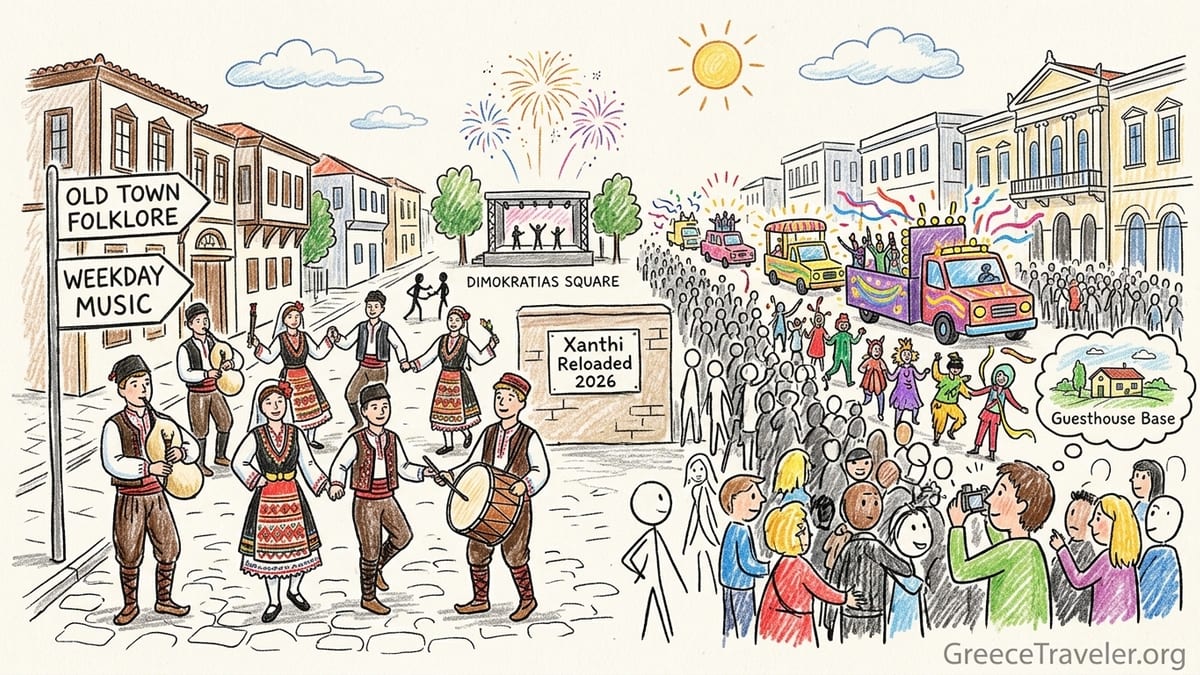
After splitting my time in 2026, I now see Xanthi Carnival as two overlapping festivals. The first is a cultural season spread over nearly four weeks, with concerts, folklore evenings, smaller parades and traditional customs in the city and surrounding villages. The second is a concentrated, three-day explosion of crowds and spectacle at the end, when those 300,000 visitors descend.
On the quieter weekdays, I attended a folklore night at the Municipal Amphitheatre where local associations and guest groups from Serbia and Cyprus performed carefully choreographed dances in traditional dress. The hall was full but not overflowing. I could see details of embroidery and listen to the stories behind each dance. Admission was free or modestly priced, and afterward I ate in a taverna where the waiter had time to explain regional dishes and local wines. It felt like tourism and cultural exchange at a human scale.
Compare that with the final Sunday parade. The Grand Parade in 2026 ran for hours and involved dozens of floats and thousands of costumed participants. The sound was overwhelming: brass bands, DJs on trucks, whistles, chants from university groups, commentary over loudspeakers. From a distance, especially in drone footage and photographs, it looked spectacular, and being in the middle of it gave me a genuine thrill. But there was no real possibility of engaging with the meaning of the costumes or the folklore references. Everything rushed past in a blur of smoke, confetti and plastic cups.
If I had to choose only one mood, I would now prefer the opening days or a mid-festival weekday, when the city is already dressed up and busy but still breathable. You can still catch major concerts in the square, sample food from the associations, hear the same bands that later march in the parades, and explore Xanthi’s historic sights without elbowing your way through a festival-sized traffic jam. The final weekend, in contrast, felt like a trade of depth for scale.
The Takeaway
So is the main parade worth it? For some travelers, absolutely. If you love dense crowds, want to be part of one of the biggest carnival gatherings in northern Greece and do not mind sacrificing comfort, sleep and budget discipline for a single massive experience, the final weekend delivers. Standing under a shower of confetti on 28is Oktovriou as the Grand Parade passes, with drums thundering and fireworks reflected in the neoclassical facades, is something you are unlikely to forget.
From my own perspective, though, the price of that memory was higher than I expected. Between inflated central hotel rates, long walks from distant parking, 45-minute food queues, shoulder-to-shoulder crowds and nightlife noise that never really stopped, I felt that the last weekend of Xanthi Carnival pushed beyond what I would recommend to most travelers who want to enjoy both the city and the festival. The cultural richness that defines the Thracian Folklore Festivals was easier to appreciate earlier in the program, when Old Town alleys were still lively but not impassable and locals had time to talk rather than shout over the music.
If I were planning a return trip, I would personally aim for the period from the official opening on January 28 through around the middle of the festival, perhaps leaving before the crush of the final Saturday and Sunday. I would avoid arriving on the main parade weekend without a confirmed bed and a clear plan for where to park or how to move around. I would treat the children’s parade and other family events as potential highlights, but I would also build in flexibility and monitor official updates in case weather or safety concerns forced changes, just as they did in 2026.
For travelers determined to see the Grand Parade, I would suggest a hybrid approach: stay outside Xanthi in a village guesthouse to contain costs and secure quiet nights, drive in very early on parade days to beat the closures, eat an early main meal away from the core before the rush, and focus on one or two key points along the route rather than trying to see everything. Above all, leave room in your schedule for Xanthi itself: visit the Folklore and Historical Museum, walk the riverside, climb up to the fortress views and wander the Old Town by daylight. The carnival is a spectacular lens on the city, but the city deserves to be seen without a wall of confetti between you and its streets.
FAQ
Q1. When did Xanthi Carnival take place in 2026?
In 2026 the Thracian Folklore Festivals and Xanthi Carnival ran from January 28 to February 23, with the Grand Parade on Sunday, February 22 and Clean Monday on February 23.
Q2. How busy did the final weekend of Xanthi Carnival feel?
Municipal sources spoke of roughly 300,000 visitors over the peak three days, and on the ground that translated to packed streets, dense parade crowds and heavy traffic at every entrance to the city.
Q3. Are hotel prices in Xanthi during carnival really double the normal rate?
In 2026 central hotels were significantly more expensive on the final weekend, but closer to 40 to 70 percent higher than regular winter weekends rather than a universal price doubling, with the biggest pressure coming from limited availability and minimum stays.
Q4. Is it better to stay in the center or outside Xanthi during carnival?
Staying centrally is convenient for walking to events but exposes you to nonstop noise, crowds and access issues, while a countryside base 10 to 20 minutes away can offer lower prices, easy parking and quieter nights in exchange for daily drives.
Q5. What is the difference between the children’s parade and the main Sunday parade?
The children’s parade is a daytime procession focused on local schools and families, smaller in scale and more relaxed, whereas the main Sunday parade is a long, high-intensity spectacle with floats, folklore groups and thousands of participants filling the city.
Q6. Why was the children’s parade in 2026 postponed?
In 2026 bad weather with heavy rain and strong winds on the scheduled Sunday led the municipality to postpone the children’s parade for safety reasons, highlighting how vulnerable outdoor events are to February conditions.
Q7. How important are official municipal updates during Xanthi Carnival?
They are crucial, because they provide last-minute information on weather-related changes, road closures, parade timings and rescheduled events, and relying only on printed programs or second-hand summaries can leave you standing in the wrong place at the wrong time.
Q8. Can I still enjoy Xanthi’s historic sights during the final weekend?
It is possible but harder: museums, Old Town alleys and viewpoints remain open, yet the dense crowds, road closures and noise make slow sightseeing more stressful, which is why many visitors prefer exploring them on quieter weekdays earlier in the festival.
Q9. How far in advance should I book accommodation for the peak weekend?
For the 2026 edition, central hotels were heavily booked by early January, so securing a room two to three months in advance was a safer window, especially if you wanted a particular property or price level.
Q10. If I dislike big crowds, which Xanthi Carnival dates would you recommend?
Based on my 2026 experience, I would choose the opening days and mid-festival weekdays between late January and early to mid-February, when concerts, folklore events and smaller parades are in full swing but the city is still breathable and accommodation more reasonably priced.